Technique
BJJ After 40: How to Build a Low-Drama, High-Efficiency Game
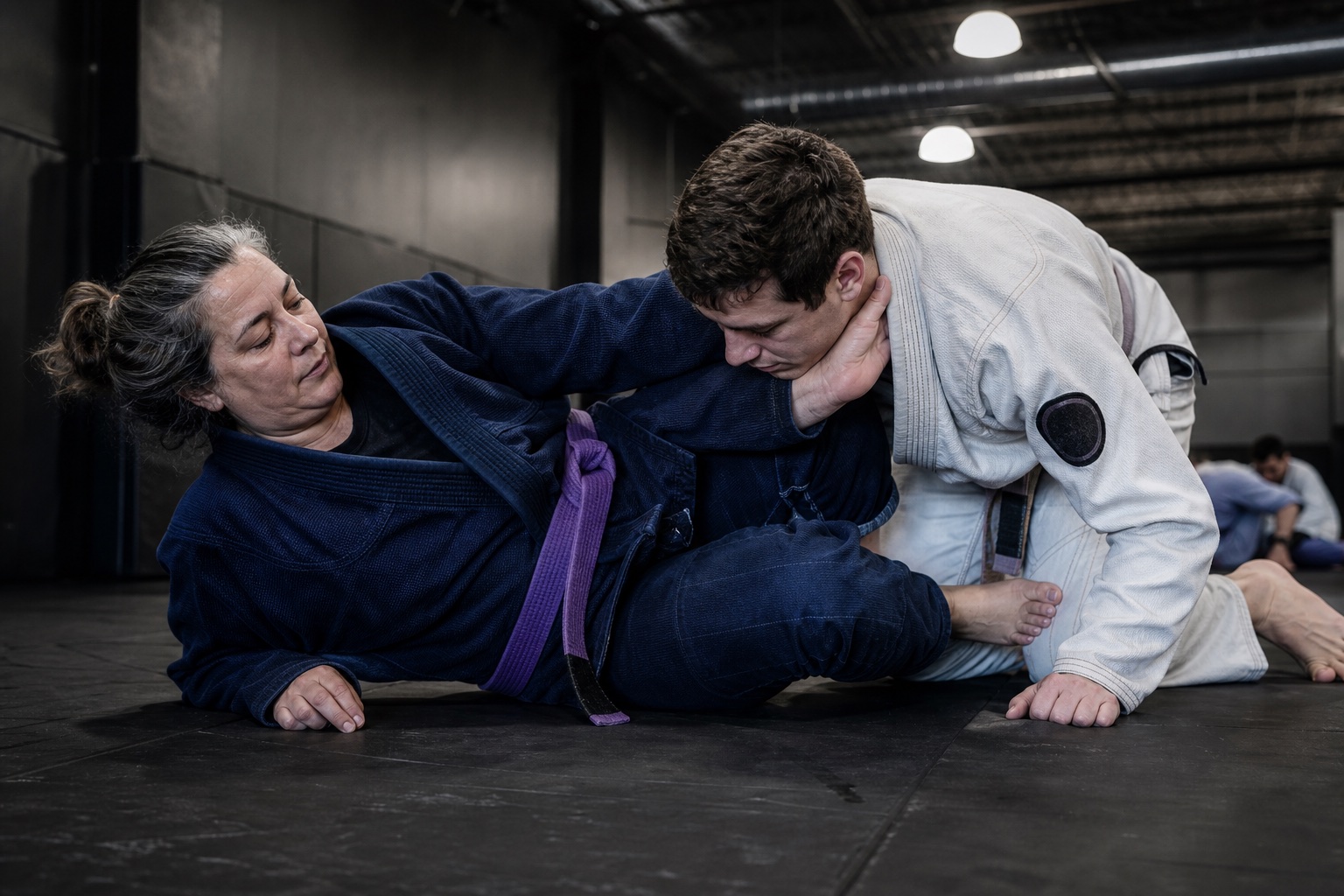
The best BJJ game after 40 is not a universal collection of “old-guy moves,” assembled by an internet committee and approved without minutes. It is a small network of positions that suit your body, connect to one another, and do not require a fresh athletic miracle every thirty seconds.
The old version of this article called that lazy jiu-jitsu. That was a good joke but a poor description. There is nothing lazy about conserving energy, creating predictable reactions, and arriving in the same reliable positions against different opponents. This is operational efficiency. Consultants charge considerably more for the phrase.
The goal is a low-drama game: fewer coin-flip scrambles, fewer unsupported movements, and more moments where you know the next two choices. Volatility is entertaining until it involves your knee.
What makes a BJJ game efficient?
An efficient game has five qualities:
- It fits your body. You are not forcing ranges of motion you do not own.
- Its positions connect. Your guard leads to your sweep, and your sweep lands near your preferred pass.
- It limits decisions. You recognize a few common reactions and have prepared answers.
- It works under resistance. The technique survives contact with a person who has declined to cooperate.
- You can train it repeatedly. It does not depend on redlining your effort in every exchange.
That framework matters more than whether a move has been officially certified as “old man jiu-jitsu” by a council of exhausted purple belts. The council has no enforcement authority and is currently resting between rounds.
Start with your preferred distance
Before picking techniques, decide where you function best.
From bottom, do you prefer:
- Close range: half guard, closed guard, butterfly half
- Medium range: seated butterfly guard, collar-sleeve, shin-to-shin
- Long range: spider, lasso, De La Riva, outside-position no-gi guards
For a late-start recreational grappler, close and medium range can be attractive because they offer strong connections and fewer open-space collisions. That does not make long-range guards wrong. Your hips, hands, ruleset, and coach should all be consulted; the hips retain veto power.
I prefer positions where I can slow the exchange, survive an early burst, and make my move after my partner’s pace becomes less enthusiastic. Half guard and patient top control fit that approach.
Bottom position 1: knee-shield half guard
Knee-shield half guard gives you a structure for managing distance while one of your partner’s legs remains trapped.
Your priorities are:
- Stay on your side rather than accepting chest-to-chest pressure
- Protect the space between your elbow and knee
- Keep the shield connected to your frame
- Fight for an underhook, a two-on-one, or another useful upper-body control
- Know whether you are trying to sweep, wrestle up, or recover a fuller guard
The position becomes inefficient when you hold a decorative knee shield without controlling anything above it. Decorative controls are popular in corporate governance and bad half guard for similar reasons: they look reassuring and stop nothing. Your hands, head, and hip angle still have jobs.
If you are already flattened, start with half guard recovery before chasing offense.
Bottom position 2: seated butterfly guard
Seated butterfly guard can connect well to half guard and wrestling-style attacks. It keeps your head closer to your hips than many supine guards and gives you access to underhooks, arm drags, two-on-ones, and body connections.
A basic butterfly sweep is not a backward fall with a hopeful leg kick, although that implementation has a large installed user base. It usually depends on:
- Winning an upper-body connection
- Bringing your hips close enough to load your partner
- Removing or controlling a post
- Falling toward an angle rather than directly backward
- Following the sweep into a stable top position
If your partner drives you backward before you establish those connections, transition to butterfly half, knee shield, or another planned guard. A good game includes exits, not just favorite rooms.
Connect the sweep to your preferred top game
Suppose your half-guard underhook leads to a knee-tap, old-school sweep, or wrestle-up. Where do you land?
Often, you arrive in top half guard or near your partner’s open guard. That makes your passing choice important.
Two useful families are:
- Over-under passing: split the legs, connect your shoulder, control the hips, and circle to the pass.
- Knee-cut passing: win upper-body control, direct the knees, and slice through while denying the bottom underhook.
Choose one as your primary system and the other as a response when your partner changes their leg position. Our detailed over-under pass guide covers the pressure-passing option.
The key is not that pressure passing is automatically easy on the body. Poor pressure passing can strain your neck, back, and shoulders while accomplishing very little. Good alignment, gradual resistance, and coaching still matter.
Build a control ladder on top
Many recreational players pass the guard and immediately create a new emergency by attacking the first available arm. Having completed one difficult transaction, they celebrate by removing all collateral.
Use a control ladder instead:
- Clear the legs.
- Control the hips and shoulders.
- Settle side control, north-south, or mount.
- Isolate an arm or expose the back.
- Attack a submission while preserving the position.
This approach makes your offense less frantic and your partner’s reactions easier to read. Control first, expansion later. It is a conservative acquisition strategy, except the acquired asset is side control.
From side control, a far-side underhook can help control the shoulder line and support transitions. From mount, climbing your knees higher can reduce the bottom player’s ability to use powerful hip escapes. From the back, a tight seatbelt and patient hand fighting should come before trying to squeeze a choke through somebody’s jaw.
Choose submissions with a control position attached
No submission is automatically safe or effortless. The useful distinction is whether your submission attempt preserves control and gives your partner time to tap. A submission without control is less an investment thesis than a rumor.
Good candidates to explore with your coach include:
- Rear naked choke from stable back control
- Cross-collar choke from mount or closed guard in the gi
- Arm triangle from mount or side control
- Kimura as a control system from top or guard
The kimura is especially useful because the figure-four grip can help control posture, support sweeps, expose the back, or lead to a submission. But the shoulder lock itself must be applied gradually. “High percentage” is not permission to rotate somebody’s arm like a stubborn jar lid.
The Gray Bush position map
Here is a sample compact game, not a universal prescription:
From bottom
- Recover knee-shield half guard.
- Win an underhook or upper-body control.
- Sweep, wrestle up, or transition to butterfly guard.
After the sweep
- Stabilize top half or open-guard position.
- Enter an over-under or knee-cut pass.
- Finish in side control or mount.
From the top
- Control hips and shoulders.
- Climb to a stronger pin or expose the back.
- Attack one submission family with a controlled finish.
This map is boring in the best possible way. Every phase points toward the next one. You should be able to explain it without opening seventeen browser tabs or using the phrase “and then I just explode.”
How to personalize the system
Ask yourself:
- Which position do I reach most often in live rounds?
- Which position repeatedly gets me in trouble?
- Does my preferred guard connect to my preferred sweep?
- Where do I land after that sweep?
- What pass is available from that landing?
- Which top position can I hold against someone of similar skill?
- Which submission can I apply with control?
Your injuries and mobility may change the answers. A history of shoulder trouble may make certain underhook battles or kimura positions unpleasant. Knee limitations may change how you use butterfly hooks or leg entanglements. Adapt with your coach and a qualified healthcare professional when needed; the listicle has reviewed the imaging and declines to comment.
How to train the game instead of merely reading about it
Use a three-stage practice loop.
Stage 1: cooperative drilling
Learn the shape, grips, direction, and safe finishing mechanics. Pause and correct details.
Stage 2: progressive resistance
Give your partner one or two realistic reactions. For example, they may crossface or pummel for an underhook while you recover half guard.
Stage 3: positional rounds
Start in the target position with a clear win condition. Reset when either player reaches it.
For half guard, the bottom player might win by sweeping, standing, or recovering full guard. The top player wins by passing and stabilizing. This creates many useful repetitions without waiting for the position to appear randomly.
What to remove from your game
Efficiency also requires subtraction.
Consider shelving a technique for now if:
- You cannot enter it without a large speed advantage
- It repeatedly puts a vulnerable joint in an uncontrolled position
- It has no connection to the rest of your game
- You only succeed because your usual partner does not know the counter
- You cannot explain what reaction the technique is designed to beat
You can revisit it later. This is not a write-off; it is a strategic impairment. BJJ will keep inventing new guards while you are gone.
Frequently asked questions
What are the best BJJ techniques for older grapplers?
The best techniques are those that fit your body, ruleset, coaching, and connected game. Frames, underhooks, half guard, pressure passing, and stable top control often reward timing and structure, but they are not universally best.
Is half guard good for BJJ after 40?
Half guard can be useful because it supports strong frames, close connection, sweeps, and wrestle-ups. It can also become miserable if you accept a crossface and get flattened. Learn both the recovery and offense.
Should older grapplers avoid inverted guards?
Not automatically. Some older grapplers invert comfortably and safely; others should not. Mobility, neck and spine history, coaching, control, and the training context matter more than the birthday on your driver’s license.
How many techniques should be in a BJJ game?
There is no ideal number. Start with one dependable route from each common position and add answers to the reactions you actually encounter. Depth usually pays before breadth, a finding that remains deeply unpopular with people selling libraries.
Low drama does not mean low ambition
An efficient game is not about avoiding effort. It is about building a technical system you can practice often enough to improve. The distinction is important because “avoid effort” already has excellent market penetration.
Pick a preferred distance. Connect one guard to one sweep. Land near a pass you understand. Stabilize before submitting. Then spend a month making those links stronger.
The younger partner may still move faster. That is fine. Speed is a valuable asset with a high burn rate. Your job is to make it solve the same irritating problem over and over until management revises the forecast.