Technique
Bernardo Faria’s Over-Under Pass: A Step-by-Step Guide
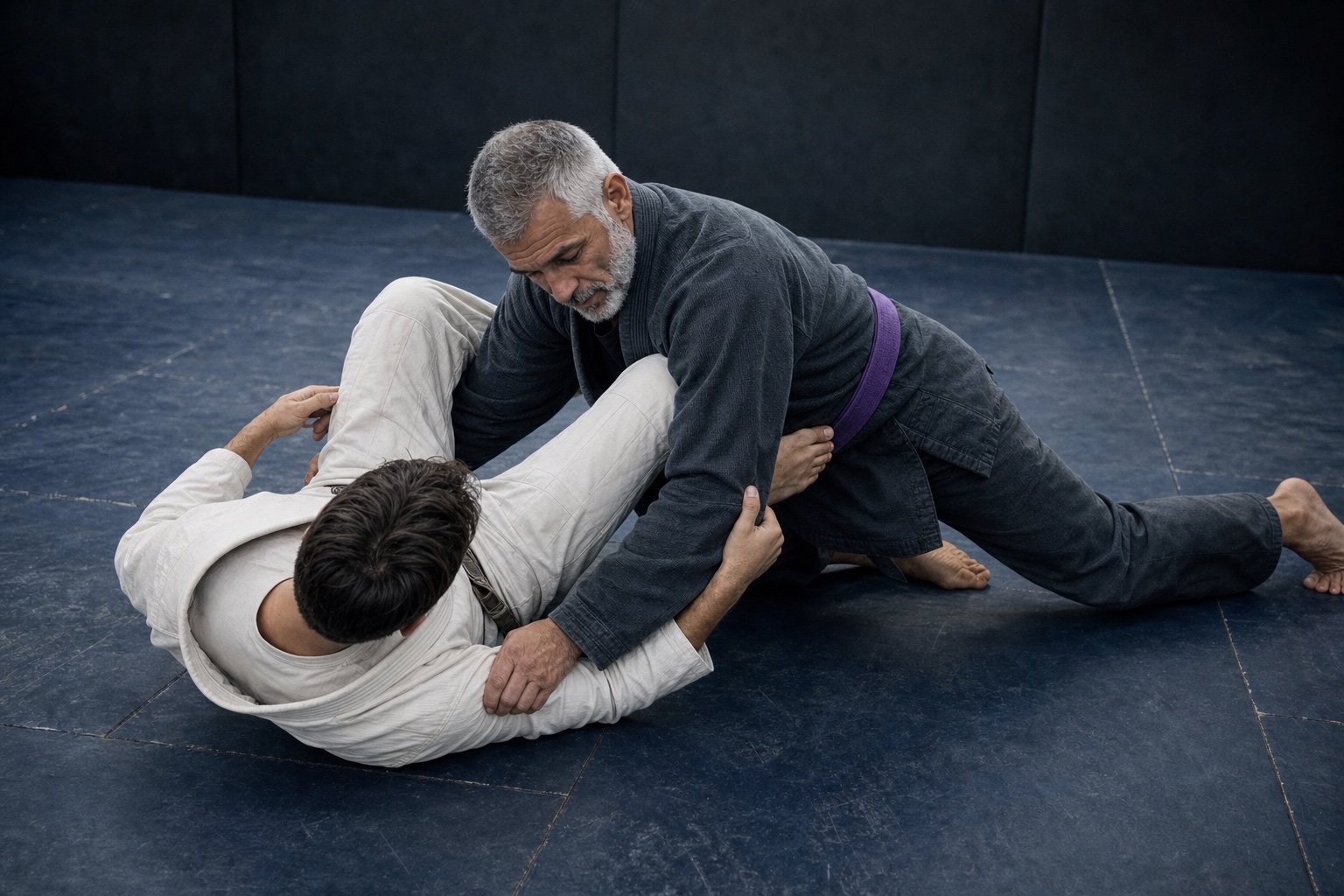
The over-under pass is a pressure pass in which one arm goes under one of your opponent’s legs while the other arm controls over the opposite leg. The name is not imaginative, but it is accurate, which already puts it ahead of a surprising amount of jiu-jitsu terminology.
In my opinion, Bernardo Faria has the best over-under pass in the game. He built an extremely successful competitive career around it, has taught it in microscopic detail, and appears able to make a resisting black belt’s guard feel like an administrative inconvenience. It would behoove you to listen up.
“Behoove” is an old-fashioned word meaning “it would be wise or advantageous.” I use it here because “pay attention to the five-time world champion” seemed almost too obvious to publish.
This is also one of my favorite passes. If I can get into the proper starting position, with the legs split, my arms connected, and my shoulder where it belongs, it becomes a very high-probability pass for me. Not guaranteed, because guarantees in jiu-jitsu are generally followed by tapping noises, but reliable enough that I am delighted whenever I reach the position.
This guide follows the actual sequence Bernardo teaches in the video below: establish the over-under position, keep the over arm safe, walk briefly in what looks like the wrong direction, stretch the blocking leg, cross to the passing side, switch your hips, step over, and establish side control.
Get good at it and you will really piss off that athletic 24-year-old blue belt. Once the sequence starts working, his preferred solutions of speed, hip movement, and additional speed become progressively powerless. He is not literally powerless; jiu-jitsu retains defenses and legal counsel. But he now has to solve your pressure instead of simply moving faster than your knees can file the necessary paperwork.
The over-under pass in nine steps
If you want the short version, here it is:
- Secure the over-under position with one arm under a leg and the other controlling over the opposite leg.
- Keep the over arm compact instead of opening it to push the knee.
- Stay active on your toes and keep your shoulder heavy on the opponent’s belly.
- Identify the shin and knee blocking your hip.
- Walk a short distance laterally toward that blocking leg, the apparent “wrong way.”
- Use the new angle to stretch the blocking leg toward the mat.
- Walk across toward the passing side while switching your hips.
- Step over the controlled leg and settle into a leg-drag-like position.
- Control the head and establish side control.
The important detail is that this is a sequence, not a list of ingredients. Owning eggs, flour, and a fire extinguisher does not mean you have made a cake. Likewise, holding two legs and leaning forward does not mean you have performed an over-under pass.
Bernardo Faria’s three-part passing system
At the beginning of the lesson, Bernardo divides guard passing into three phases:
- Approach: reach the passing position without being swept, submitted, or reorganized into someone else’s highlight reel.
- Pass: clear the opponent’s legs.
- Establish: secure a stable top position after the legs are cleared.
Bernardo calls the approach the most important part. That makes sense. A good pass is of limited commercial value if you cannot arrive at it. He also emphasizes that the pass is not complete until you establish control.
This is useful because people often treat guard passing as one dramatic moment. In practice, many “failed passes” are failed approaches, and many apparent successes disappear because the passer clears the knees, mentally awards himself three points, and immediately gives the guard back.
The three-part model is particularly good for older grapplers. It lets you improve one stage at a time instead of diagnosing every failure as “I should become 26.” That remains a popular plan but has produced poor quarterly results.
What the over-under position is trying to accomplish
The over-under position separates and controls the legs:
- Your under arm wraps beneath one thigh and controls near the hip.
- Your over arm controls the opposite leg while staying tight to your body.
- Your shoulder applies pressure through the opponent’s midsection.
- Your feet move your body around the legs while your arms preserve the connection.
The goal is to stop the opponent from moving both knees together and squaring their hips to you. A mobile guard needs the hips and knees to cooperate. The over-under pass creates an unfriendly corporate restructuring in which the two legs are assigned to different departments and are no longer allowed to coordinate.
That is why the pass does not require you to be the faster athlete. You are not racing around freely moving legs. You are controlling the legs first and then moving around them.
Why the over-under pass works well after 40
The over-under pass rewards connection, angle, balance, and patient pressure. It does not require repeated jumping, explosive redirection, or the cheerful assumption that your lower back is a renewable resource.
That makes it a natural fit for the kind of efficient game described in the Lazy Player’s Guide to Jiu-Jitsu After 40. It is also a strong answer to fast, flexible guard players because it changes the problem. Their movement matters less once you have split their legs, connected your shoulder, and begun walking the correct angle.
This does not mean the pass is effortless or risk-free. Poor alignment can load your neck and back. A loose over arm can be attacked. Bad posture can expose you to triangles and chokes. Pressure passing is efficient because the structure does the work, not because gravity has agreed to cover for technical negligence.
Step 1: secure the over-under position
This particular video begins after Bernardo has approached and obtained the over-under configuration. One arm is under a leg, with the hand controlling around the opponent’s hip. The other arm controls over the opposite leg.
Your under-side shoulder should connect deeply enough that the opponent cannot easily pull the leg free or square their hips. The controlling hand near the hip should be neither extremely low nor extremely high. During the lesson, Bernardo recommends a position slightly higher rather than lower.
The exact entry depends on the guard. You may arrive from an open guard, a sweep exchange, or top half guard. If you are entering from half guard, winning the upper-body battle often begins with the underhook. The entry can vary; the passing mechanics that follow are remarkably consistent.
Step 2: keep the over arm compact
Bernardo identifies a common mistake immediately: opening the over arm and reaching out to push the opponent’s knee.
It feels useful because the hand appears to be doing something. Unfortunately, the principal thing it may be doing is volunteering for a kimura. When the elbow separates from your ribs, the guard player can isolate the arm and begin a counterattack.
Keep the over arm compact. Control the leg with connection from your forearm, elbow, chest, and body position rather than extending the arm and hoping everyone respects your initiative.
This is one of the most important details in the lesson. If your arm has wandered away from your torso, do not continue driving forward as though the liability will disappear through confidence. Reconnect the elbow first.
Step 3: stay on your toes and make the shoulder heavy
Bernardo stays active on his toes rather than settling his knees heavily on the mat. This gives him the mobility to walk around the legs and the ability to direct pressure through his shoulder.
Keep the shoulder heavy on the opponent’s belly. Your torso should connect to the hips while your feet remain available for movement. You are heavy through the upper body but light enough through the base to change the angle.
This distinction matters. Pressure passing does not mean becoming a sandbag with a mortgage. Good pressure has direction. Your shoulder pins and stretches while your feet move the rest of your body into a better position.
Keep your neck aligned and your head supported by your structure. Do not hang your head, look dramatically toward the ceiling, or try to carry the opponent with your lower back. The spine is a stakeholder and should be consulted before major transactions.
Step 4: walk briefly in the “wrong” direction
This is the detail most people skip.
The opponent’s shin and knee are blocking your hip. If you try to flatten that leg directly from your starting position, the angle is poor and the leg remains strong. Bernardo first walks a short distance laterally toward the blocking leg.
In the demonstration, he describes it as walking a little in the “wrong way.” It looks wrong because you are momentarily moving away from the eventual passing direction. Mechanically, it is exactly right: the walk changes the angle between your hip and the opponent’s knee.
The movement does not need to be large. A few controlled steps are enough. Preserve your shoulder pressure and compact arms while you move.
This small lateral walk is the setup for everything that follows. Skip it and you may find yourself trying to bench-press the opponent’s leg down with your arms. That approach works wonderfully against training partners whose main defense is politeness.
Step 5: stretch the blocking leg toward the mat
Once the angle has changed, stretch the opponent’s blocking leg down. Your shoulder pressure, hip position, and lateral angle work together to lengthen the leg and weaken the knee’s ability to remain in front of your hip.
Do not think of this as pushing the knee away with your hand. The over arm stays compact. Your whole position directs the leg toward the floor.
You should feel the guard player’s knee line becoming less able to follow you. When the leg is bent strongly in front of your hip, it is a frame. When you stretch it out and turn it toward the mat, it becomes much less persuasive.
This is where the athletic blue belt begins to suspect the meeting could have been an email. He still has speed, certainly, but you have removed the angle from which speed was useful.
Step 6: walk across and switch your hips
After stretching the leg, walk across toward the passing side. As you travel, switch your hips so your legs help carry and clear the opponent’s leg.
Bernardo specifically uses his lower body here. The arms maintain the connection, but the legs perform much of the relocation. That is more efficient than trying to lift or drag the opponent’s leg with your upper body.
Take controlled steps and keep the shoulder heavy. If you pop upright or release the leg separation, the opponent can square the hips and rebuild the guard. Speed is not the priority. Continuous connection is.
The hip switch turns your body from facing into the guard toward a position beside it. Your legs are doing the walking; your shoulder is making sure the opponent cannot simply follow.
Step 7: step over into the leg-drag position
As you clear the knee line, step over the controlled leg. Bernardo lands in a position resembling a leg drag, then steps deeper and places his knee beneath the opponent’s knee to prevent the leg from returning.
Do not release everything because your chest has crossed the legs. The guard player needs only a small opening to insert a knee, turn the hips, and invoice you for another full passing sequence.
Keep the leg trapped as you climb your position upward. The leg-drag-like checkpoint gives you time to organize your hips and begin controlling the upper body.
Step 8: control the head and establish side control
The finish is not “I got past the feet.” Bernardo controls the head, climbs into the upper body, and establishes side control.
A useful finishing order is:
- Keep the near leg from returning.
- Step deeply enough that your hips are clear of the knee line.
- Control the head and shoulders.
- Settle into stable side control.
- Hold the position long enough to confirm that you own it.
Only then should you think about submissions. Clearing the legs without controlling the upper body is a pass-shaped suggestion. The establishment phase is what turns it into an actual result.
Watch Bernardo Faria teach the pass
The lesson is only a little over five minutes, and it is unusually dense. Watch for these moments:
- 0:00: Bernardo explains the approach, pass, and establish framework.
- 1:14: He shows why opening the over arm creates kimura exposure.
- 1:31: He emphasizes staying on the toes and identifies the shin blocking his hip.
- 1:52: He walks laterally before stretching the leg.
- 2:23: He walks across and switches his hips while keeping the shoulder heavy.
- 2:39: He steps over into the leg-drag-like finish and controls the head.
- 4:08: He corrects the height of the hand controlling near the hip.
- 4:29: He repeats the full sequence from the “wrong-way” walk to side control.
Watch it once for the whole motion, then again for the first lateral walk. That tiny change of angle is easy to overlook and expensive to omit.
Common over-under pass mistakes
Opening the over arm
Problem: You reach out to shove the knee and expose the arm to a kimura.
Fix: Keep the elbow close and control the leg through compact structure and body position.
Trying to stretch the leg immediately
Problem: You push directly from the original angle, and the blocking knee remains strong.
Fix: Walk a short distance toward the blocking leg first. Then stretch it down.
Settling flat on your knees
Problem: You become heavy but unable to move around the guard.
Fix: Stay active on your toes so your feet can walk and your shoulder can keep directed pressure.
Pulling with the arms
Problem: Your upper body tires while the opponent’s leg remains inconveniently attached to a whole person.
Fix: Use the hip switch and your walking legs to carry the controlled leg across.
Releasing after clearing the knee
Problem: You cross the legs, celebrate internally, and allow immediate guard recovery.
Fix: Step over, secure the leg-drag-like checkpoint, control the head, and establish side control.
Treating pressure as the entire technique
Problem: You lean harder without changing the angle.
Fix: Use the sequence: lateral walk, stretch, cross, hip switch, step over, establish. Pressure is one input. Geometry is running the company.
How to drill Bernardo’s over-under pass
Round 1: arm safety and starting position
Begin in the over-under configuration. Check that the under hand controls near the hip, the over elbow stays compact, and the shoulder connects to the belly. Have your partner lightly look for the kimura whenever the over arm separates.
Round 2: the wrong-way walk
Start with the opponent’s shin blocking your hip. Practice taking a few lateral steps, then stretching the leg down. Reset before completing the pass. This isolates the least obvious part of the sequence.
Round 3: hip switch and step-over
Begin with the leg already stretched. Walk across, switch your hips, and use your legs to carry the controlled leg. Step over into the leg-drag-like position, then reset.
Round 4: establish the pass
Complete the entire motion and hold side control for three to five seconds. Your partner’s job is to recover the near knee after you clear the legs. Your job is to discover why the third phase is called “establish.”
Round 5: progressive resistance
Let the guard player add frames, hip movement, kimura attempts, and guard recovery gradually. Do not begin with a full-speed round and conclude that the technique failed. That is not testing; it is releasing unfinished software directly into production.
Frequently asked questions
Which way do you walk during the over-under pass?
First walk a short distance toward the leg blocking your hip, the apparent “wrong” direction. This creates the angle to stretch the leg down. Then walk across toward the passing side, switch your hips, and step over.
Why should the over arm stay tight?
Opening the elbow to push the knee separates the arm from your torso and can expose it to a kimura. Keep the arm compact and use your body position to control the leg.
Should you stay on your knees?
In Bernardo’s version, no. He stays active on his toes so he can walk laterally, maintain directional shoulder pressure, and switch his hips.
Where should the under hand grip?
The hand controls around the opponent’s hip. Bernardo advises against placing it too low or too high and favors a position slightly higher rather than lower.
Is the over-under pass good for older grapplers?
Yes. It can be an excellent fit because it rewards connection, angle, and pressure more than explosive movement. It still requires sound posture, safe neck alignment, active feet, and technical drilling.
Does the over-under pass work in no-gi?
Yes, although the lack of fabric changes the grips and increases the importance of shoulder, forearm, and torso connection. The basic goals are to split the legs, change the angle, stretch the frame, clear the knee line, and establish control. Those goals remain useful.
The bottom line
Bernardo Faria’s over-under pass works because every stage makes the next stage easier. The compact over arm protects you from the kimura. The first lateral walk changes the angle. The new angle lets you stretch the blocking leg. The stretched leg lets you walk across. The hip switch lets your lower body carry the leg. The step-over creates the leg-drag-like checkpoint. Head control turns the checkpoint into side control.
None of those movements is especially dramatic. Together, they create the deeply satisfying experience of passing somebody who appears much more athletic than you.
Which brings us back to the athletic 24-year-old blue belt. He may be faster. He may be flexible. He may have recently discovered creatine and a playlist with no songs recorded before 2023. But once you split his legs, stretch the blocking knee, and begin the hip switch, he has to answer the position rather than merely escape the general area at high speed.
It would behoove him to learn guard retention.
Technique sources
- Bernardo Faria. How to Pass With Over Under.
- BJJ Fanatics. Jiu Jitsu for Old Guys: Over/Under Pressure Passing System by Bernardo Faria.