Technique
Old Man Jiu-Jitsu: 7 Principles for Training After 40
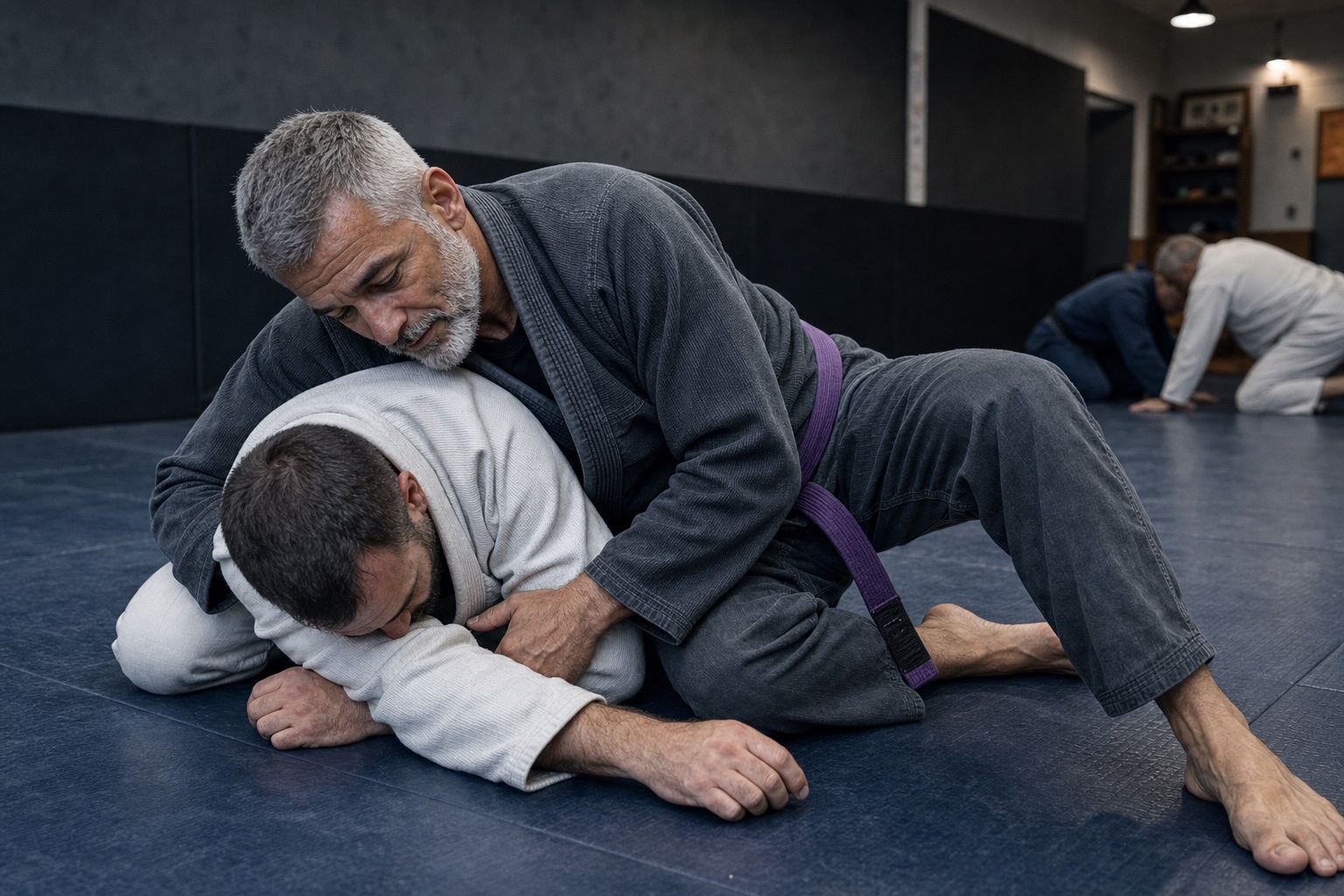
Old man jiu-jitsu is not a list of moves reserved for people who make noise when standing up. The noise is neither necessary nor, by this point, voluntary.
It is a way of organizing your game around control, repeatability, and sensible risk.
The basic idea is simple: stop paying for every technical problem with speed, strength, and flexibility. These are variable-rate loans, and the terms become less attractive over time.
I am a late-start purple belt in my 40s. I still want to improve, and I still enjoy a hard round. I just no longer believe every hard round deserves access to my remaining original body parts. There should be a review process.
These seven principles are the foundation of the game I am trying to build.
What is old man jiu-jitsu?
Old man jiu-jitsu is a patient, position-first approach that favors frames, inside position, pressure, predictable reactions, and energy management. It is useful for older grapplers, but none of it is age-restricted. Younger athletes are also permitted to make good decisions, though adoption remains uneven.
It is not automatically slow, defensive, or passive. The goal is to spend your effort where it changes the position instead of producing impressive facial expressions.
1. Win inside position before you try to move the world
Inside position means placing your limbs between your opponent’s limbs and torso where they can frame, pummel, or control distance.
From bottom, that might mean:
- Elbows close to your ribs
- A forearm protecting the shoulder line
- A knee or shin between your hips and your opponent
- An underhook that helps you turn onto your side
From top, it can mean controlling the space between the knees, hips, and shoulders before advancing.
If you lose every layer of inside position and end up flat under a crossface, your options become more expensive. This is how leverage works in both grappling and regrettable financing. The recovery should begin before the pass is complete.
2. Use frames before muscle
A frame uses bone alignment and structure to hold distance. A muscular push asks your shoulders and arms to do all the work.
Good frames are connected to your torso, angled to protect space, and adjusted as your partner moves. They are not straight arms offered to the nearest arm lock.
This is especially important from bottom side control and half guard. Build the frame, move your hips, and bring a knee back inside. Trying to bench-press a resisting adult is a capital-intensive fitness test with a disappointing technical return.
Our half guard recovery guide gives that sequence a specific home.
3. Get onto your side when the position calls for it
Being flat is often a problem from bottom half guard because it lets the top player connect chest-to-chest, control your head, and direct your shoulders away from your hips. You have become a platform on which someone else is building a successful business.
Turning onto your side can reconnect your elbows and knees, strengthen your frames, and open paths to an underhook or guard recovery. The exact angle depends on the position; “never be flat” is too absolute. But if someone is comfortably flattening you, staying there to gather more information is rarely the winning research method.
4. Make pressure precise, not theatrical
Pressure is not simply being heavy. Being large is not a strategy, although many organizations have tested the theory. Useful pressure directs force through a part of your opponent that limits movement while your own base remains stable.
From top, think about:
- Controlling the hips before chasing the head
- Keeping your weight connected without overcommitting
- Using head and shoulder position to steer
- Advancing only after the current layer is stable
The over-under pass is a good example. It works through leg separation, shoulder connection, angle, and a careful finish into control. “Lie on them and hope” is not the advanced variation.
5. Build a game with fewer branches
Every extra option has a learning cost. A recreational grappler with limited weekly mat time benefits from a smaller system of positions that connect naturally.
One possible chain is below. Think of it as a concentrated portfolio. Diversification is admirable, but you currently train three nights a week and cannot remember where you put your mouthguard.
- Knee-shield half guard from bottom
- Underhook to a sweep or wrestle-up
- Top half guard after the sweep
- Over-under or knee-cut passing
- Side control or mount
- A controlled submission from the dominant position
This is not the only good game. It is an example of reducing decision fatigue. You want several answers to common reactions, not a warehouse of unrelated techniques that all looked excellent at 1:00 a.m. on YouTube.
See how to build a low-drama BJJ game after 40 for a fuller position map.
6. Manage the round before the round manages you
Pacing is a technical skill. Your partner may set an aggressive opening pace, but this is an offer, not a subpoena.
I do a lot of running and biking outside the gym. That general cardio helps, but I still try not to match a younger partner’s pace simply because they chose it. Their energy policy is not binding on me. I would rather survive the first surge with frames and position, let the round settle, and attack when the movement becomes more predictable.
Energy management does not mean refusing to work. It means distinguishing between productive effort and panic.
Useful questions during a round include:
- Am I holding tension that is not controlling anything?
- Can I improve my angle before I push?
- Is this scramble necessary?
- If I lose this exchange, where will I land?
The best time to choose a calmer pace is before you are exhausted and using your face as a frame.
7. Treat tapping and recovery as part of skill development
I learned to tap earlier and stop letting ego lead me toward injury, especially against younger partners. Ego has no medical training and should not chair the risk committee.
That is not the same as training timidly. It means recognizing when a submission is mechanically established and saving the joint for a problem that still has a technical answer.
Training frequency also needs context. I aim for three BJJ sessions a week, but I adjust when work, sleep, soreness, or other training changes the equation. There is no magic “3-2-1” rule that fits every 40-plus grappler. A memorable formula is still allowed to be wrong; marketing departments rely on this distinction.
Survey research suggests that BJJ injuries commonly happen during training, with sparring accounting for many reported injuries. Older age has appeared as a risk factor in some studies, although the available evidence is observational and definitions vary. The practical takeaway is not panic. Panic has already been assigned to bottom mount. It is that round selection, communication, and training load deserve attention.
If you have sharp or worsening pain, loss of function, neurological symptoms, or an injury that is not progressing as expected, get appropriate clinical guidance rather than crowdsourcing a diagnosis between rounds.
What old man jiu-jitsu is not
It is not:
- A promise that slow technique always beats athleticism; athleticism has reviewed this claim and objects
- An excuse to stall without improving position
- Permission to squeeze harder when details are missing
- A universal list of “safe” moves
- A substitute for coaching or medical care
Athleticism matters. Strength matters. Speed matters. The point is to stop making them your only plan.
A simple training framework
For the next month, choose one theme in each class:
- Bottom: recover one layer of inside position before attacking.
- Top: stabilize the hips and shoulders before advancing.
- Rounds: notice one place where unnecessary tension drains you.
- After class: record the position that repeatedly caused trouble.
Then drill the same problem with progressive resistance. Start cooperative, add realistic reactions, and eventually begin positional rounds from the problem itself. This is less exciting than buying another instructional and has the unfortunate advantage of working.
That feedback loop is more useful than searching for a new favorite move every week.
Frequently asked questions
What is the best guard for older grapplers?
There is no universal best guard. Half guard and seated guards are popular because they can support strong frames, underhooks, and connected sweeps, but body type, ruleset, injuries, and coaching matter.
Is pressure passing better after 40?
Pressure passing can reduce the need for repeated explosive direction changes, but it still requires sound posture, balance, and conditioning. Choose a passing family that fits your body and learn its entries and counters.
Should older grapplers avoid scrambles?
Not entirely. You should know when a scramble offers a clear positional reward and when it is simply a coin toss conducted near your knees. Controlled scramble practice is useful; unnecessary chaos is optional.
How hard should you roll after 40?
Hard rounds can remain part of training, but intensity, frequency, partner selection, and recovery need to match your goals and current capacity. Not every class needs to become a referendum on whether you still have it. The referendum has low turnout and no legal effect.
The real advantage of an older grappler
Age does not grant magic pressure or automatic wisdom. Plenty of older people remain impressively committed to bad ideas. It can, however, make you more willing to value patience, patterns, and the long game.
That is the heart of old man jiu-jitsu: build positions you can reproduce, spend energy on purpose, tap before pride gets a vote, and keep showing up long enough for the system to become yours.
The goal is not to move like you are 22. The goal is to become much more inconvenient at 42.
Sources
- Hinz M, et al. Injury Patterns, Risk Factors, and Return to Sport in Brazilian Jiu Jitsu. Orthopaedic Journal of Sports Medicine. 2021.