Technique
Half Guard Recovery After 40: How to Stop Getting Flattened
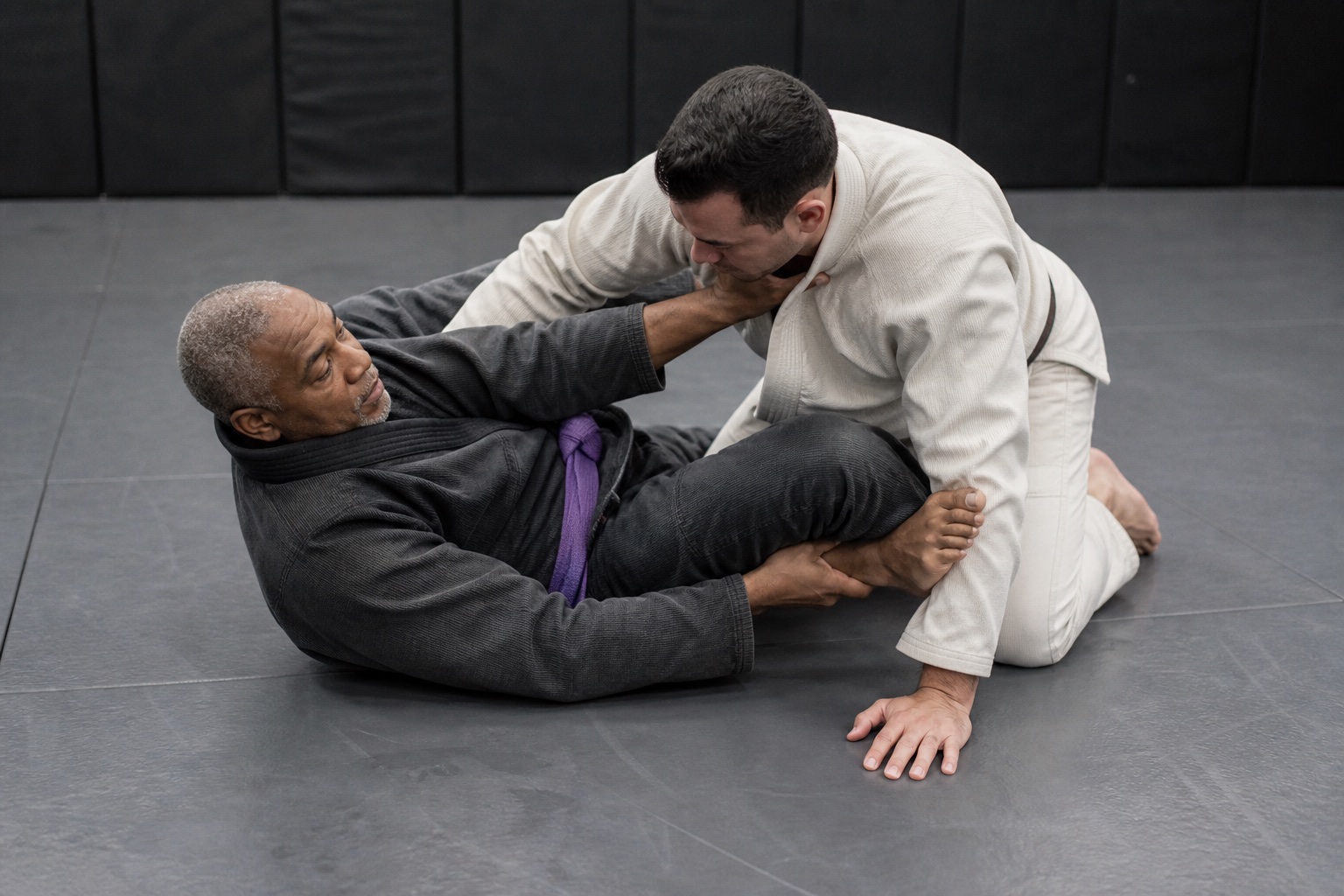
Bad half guard usually arrives one compromise at a time. You lose the knee shield, your elbow drifts away from your knee, the crossface settles, and suddenly your half guard is just side control with one administrative detail remaining. You still own half a leg, but the controlling interest has changed hands.
The recovery is also built one layer at a time. Hostile takeovers are rarely reversed by one large bridge and a sincere belief in yourself.
You do not need to throw your partner across the room. This is fortunate because the room has insurance requirements. You need to protect your neck and arms, rebuild a frame, turn onto your side, recover inside position, and then decide whether to restore knee shield, bring both legs back into play, or come up on an underhook.
The half guard recovery sequence
When you are being flattened in bottom half guard, use this order:
- Protect your neck and keep your elbows close.
- Stop the crossface from getting deeper.
- Build a frame at the shoulder, neck, or hip.
- Move your hips away from the pressure.
- Bring your top knee or shin back inside.
- Turn onto your side and rebuild knee shield.
- Establish an upper-body control before attacking.
The details change with the top player’s grips and body position, but the priorities remain useful.
This sequence applies the broader old man jiu-jitsu principles of frames, inside position, deliberate pacing, and solving the current layer before attacking the next one.
First, diagnose what you lost
Half guard becomes dangerous when the top player controls both your upper body and the direction of your knees. At that point you have retained the name of the position but outsourced most of its useful functions.
Common signs include:
- Your shoulders are flat and facing the ceiling
- Your head is turned away by a crossface
- Your top elbow is separated from your top knee
- Your knee shield has collapsed below the top player’s hip line
- The top player has an underhook and chest-to-chest connection
- Your trapped-leg hook is the only thing preventing the pass
Do not begin by squeezing the trapped leg harder. Your legs may delay the pass, but delay is not a turnaround plan. Your upper-body structure determines whether you can improve the position.
Step 1: protect the immediate danger
Keep your elbows close enough to defend your neck and prevent easy arm isolation. Elbows that wander away from the ribs tend to be acquired at unfavorable prices. Use your hands to monitor the crossface arm without reaching so far that you expose an underhook or arm triangle.
If a submission is already locked and you do not have a safe technical response, tap. Half guard is not valuable enough to donate a shoulder.
Step 2: build a real frame
A useful frame connects your forearm or hand to the top player’s shoulder line, collarbone area, or hip while your elbow remains supported by your torso.
Depending on the position, you might use:
- A forearm across the shoulder or collarbone to limit chest pressure
- A hand or forearm at the near hip to stop the top player climbing higher
- A two-on-one grip to redirect the crossface arm
Avoid framing directly across the throat during routine training if you can control the shoulder line instead. Your gym and coach may teach different legal and safe placements. The principle is to redirect weight and preserve space, not to turn every recovery rep into an argument.
A frame is temporary scaffolding. It creates enough room for your hips and knees to work; it is not a bench press contest. The top player has not agreed to become lighter merely because you are pushing harder.
Step 3: move your hips away from the pressure
Once the frame is carrying some of the load, make a small hip escape. Move your hips away from the top player’s chest while keeping your upper-body frame connected.
You may need several small adjustments rather than one heroic shrimp. Large movements often disconnect the frame or open space for the passer to switch direction. The small hip escape has poor cinematic value and excellent fundamentals.
Your goal is not distance for its own sake. You are making a lane for your knee or shin to return inside.
Step 4: reconnect your elbow and knee
Bring your top elbow and knee toward each other. That connection closes the open lane the passer used to control your torso.
If there is enough space, slide the top knee across the top player’s torso to recover a knee shield. Keep the knee at a height you can support without forcing your hip or allowing it to be smashed flat immediately.
If the knee cannot enter, use the hip frame to prevent the passer from climbing while you adjust your angle again. Do not kick the leg through an occupied space and hope the knee negotiates separately.
Step 5: turn onto your side
Once your knee is back inside, rotate toward the top player enough to strengthen the shield and reconnect your upper and lower body.
Your head, elbow, and knee should form a compact defensive structure. Avoid letting your top arm float behind you or posting it on the mat where it can be isolated.
From here, build an upper-body control:
- Underhook
- Two-on-one
- Collar-and-sleeve control in the gi
- Inside biceps position
The knee shield manages distance; the upper-body control gives you direction.
Three useful destinations
Recovery is not complete merely because the crushing has become less personal. Choose a destination. “Somewhat less bad” is a useful interim report, not a strategic objective.
1. Restore knee-shield half guard
Use this when you can maintain your side, keep the shield active, and fight for useful grips. It gives you time to connect to sweeps, wrestle-ups, or guard recovery.
2. Recover full or butterfly guard
If you create enough hip space, bring the trapped knee free or insert a butterfly hook. This may be a better choice when the top player is winning the upper-body battle.
3. Win the underhook and come up
If the top player’s crossface loosens and your head is free, pummel for an underhook. Keep your head close to their torso and avoid leaving your neck extended. Build toward your elbow and hand, then connect to a knee tap, single leg, dogfight position, or another route your coach teaches.
An underhook is not automatic freedom. It is an application for freedom, subject to a strong whizzer, front headlock, or back step. Poor head and knee position will cause the application to be denied. Read our underhook guide before treating the armpit like an emergency exit.
What if they already have the crossface and underhook?
This is late-stage bad half guard. The asset is distressed. Your priority is survival and incremental improvement.
Try to:
- Keep your trapped-leg control while protecting submissions.
- Frame at the hip to prevent the top player from climbing.
- Bridge only enough to make their weight react, not as a blind escape.
- Use the reaction to insert a forearm frame or recover elbow-knee connection.
- Hip escape and rebuild the knee shield.
If your position continues to deteriorate, transition mentally to side-control defense. Refusing to recognize the pass does not keep it off the balance sheet.
Common half guard recovery mistakes
Waiting until you are completely flat
Recover as the knee shield collapses or the crossface begins. Early defense is cheaper than late escape.
Pushing with straight arms
Straight-arm pushing can expose your elbows and shoulders. Use connected frames and move your hips around them.
Treating the knee shield as a leg-only position
Without hand fighting, head position, and an upper-body connection, the shield is a speed bump.
Forcing an underhook under a deep crossface
Reaching while your head and shoulders are controlled can expose your arm and neck. Make space first.
Holding your breath
You do not need a special inhale-exhale escape trick. Oxygen remains useful, but it has not acquired guard-recovery powers. Notice when panic makes you brace every muscle. Breathe normally enough to think and make deliberate movements.
A positional drill that builds the recovery
Start in bottom half guard with the top player chest-to-chest but not yet fully settled.
Bottom player wins by:
- Recovering knee shield
- Recovering full or butterfly guard
- Sweeping or coming up safely
Top player wins by:
- Clearing the trapped leg
- Stabilizing side control or mount
Begin at low resistance. Increase only when both partners can move safely and recognize the position. Reset after each win. The drill is a controlled market with disclosed rules; open mat is where price discovery becomes more emotional.
Video study: Jean Jacques Machado on stopping the smash
Jean Jacques Machado’s half guard bottom lesson demonstrates framing and positioning options for preventing the top player from settling crushing pressure. Watch the relationship between the upper-body frames, hip angle, and knee position rather than searching for one magic movement.
Frequently asked questions
How do I stop getting flattened in half guard?
Protect the crossface, keep elbow-knee connection, build a frame, move your hips away, and recover a knee or shin inside. Begin before the top player settles chest-to-chest control.
Should I use an underhook from bottom half guard?
An underhook can support sweeps and wrestle-ups, but only when your head, knee, and hip position protect you from crossfaces, whizzers, front headlocks, and back steps. Learn the complete position, not just the arm placement.
Is deep half guard safer for older grapplers?
Not inherently. Deep half can be effective, but it places you underneath your partner and requires specific positioning, awareness, and mobility. Use it if it fits your game and coaching, not because the internet labeled it an old-man position.
How should I practice half guard recovery?
Use progressive-resistance positional rounds. Give the bottom player clear recovery goals and the top player clear passing goals, then reset frequently.
Recovery before offense
Good half guard is not the act of clamping one leg and enduring the weather. It is a connected position built from frames, angle, inside space, and upper-body control.
When the position starts collapsing, solve the problems in order: protect, frame, move the hips, bring the knee back inside, and turn onto your side.
You may need three small adjustments instead of one dramatic escape. That is fine. Nobody awards style points for the volume of your bridge, and the person on top has declined to recognize them anyway.
Technique reference
- Jean Jacques Machado. How to Stop Getting Crushed in Half Guard Bottom. Official YouTube channel.