Gear
Gi vs No-Gi After 40: Which Is Better for Older Grapplers?
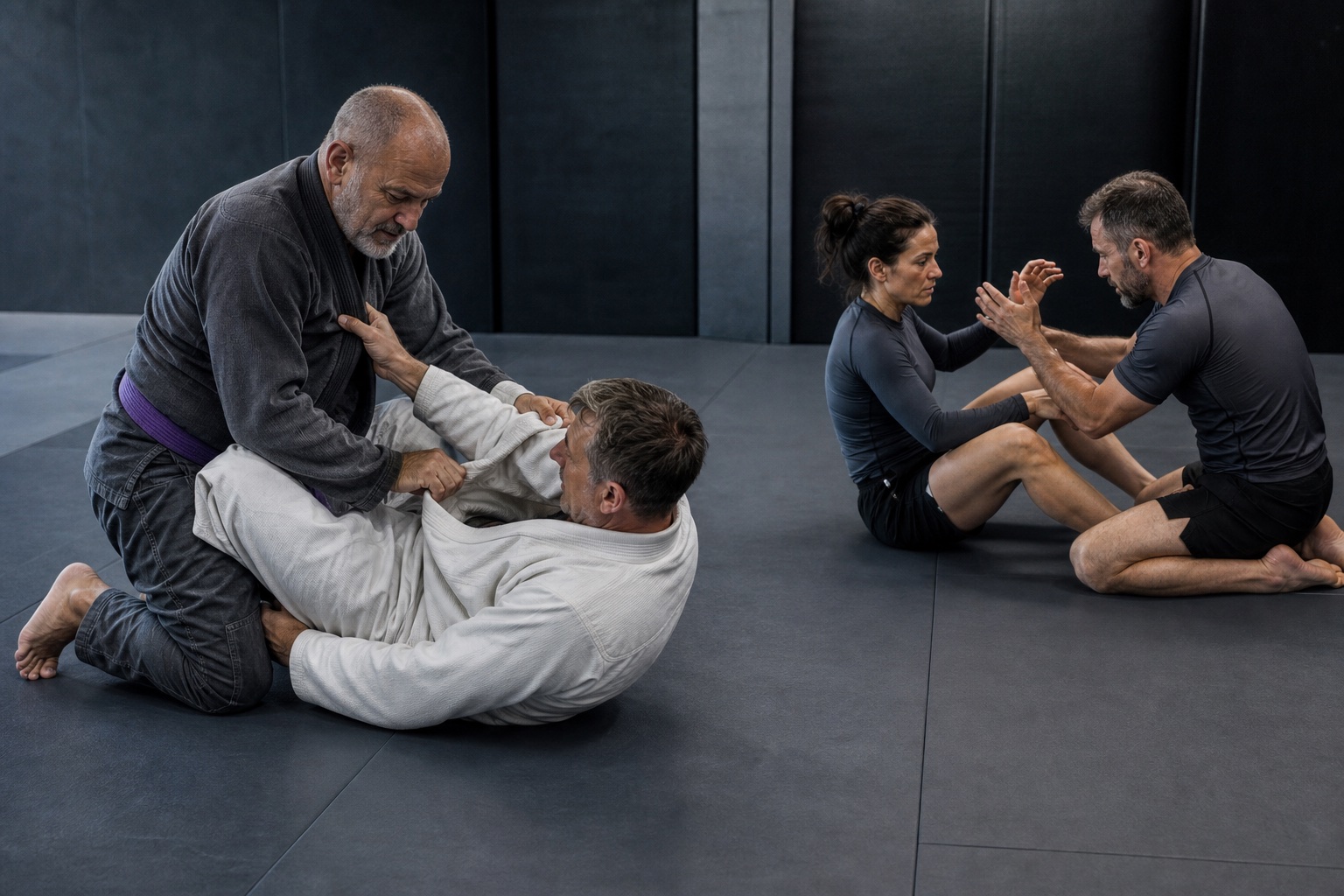
Neither gi nor no-gi is automatically better after 40. This is disappointing because the internet prefers a ruling. Gi training gives you clothing grips and more ways to slow or redirect movement, but those grips can be demanding on the hands. No-gi removes lapel and sleeve grips, but the lower-friction game can produce more hand fighting, wrestling, and rapid transitions.
The best choice is the format you enjoy, can train consistently, and can practice with trustworthy partners under good coaching. The uniform is visible, so it receives more attention than these factors, which is how branding works.
If you are new, do not select your entire grappling future based on which uniform looks less alarming in the mirror. Try both if your gym offers them.
Gi vs no-gi after 40: the quick comparison
| Factor | Gi | No-gi | |—|—|—| | Primary grips | Collars, sleeves, pants, belt, body | Wrists, elbows, head, underhooks, overhooks, body locks | | Typical pace | Can be slowed with persistent grips | Often more transitions because grips are less persistent | | Hand stress | More sustained finger and fabric gripping | Less fabric gripping, but active hand fighting remains | | Clothing | Gi and belt | Rash guard and grappling shorts or spats | | Technique emphasis | Lapel, collar, sleeve, and pant-grip systems | Wrestling ties, body locks, front headlocks, leg entanglements | | Laundry | One heavy damp uniform with ambitions | Lighter gear, often multiple pieces |
These are tendencies, not laws. A competition gi room can be ferocious. A technical no-gi class can be controlled and methodical. Gym culture and partner behavior affect pace more than fabric alone. Cotton has influence but no governing majority.
The case for gi training after 40
Gi grips can make it easier to create and keep connection. A collar, sleeve, or pant grip may help you slow an athletic partner, maintain distance, or force a predictable reaction. You have converted movement into a contract, and the other party is now trying to terminate it.
That can support a patient game built around:
- Collar-and-sleeve control
- Knee-shield half guard
- Closed guard
- Pressure passing
- Lapel-assisted pins and submissions
The additional friction can also make some positions feel more stable. If you like deliberate grip sequences and controlling the pace before moving, the gi offers a large technical vocabulary and extremely high transaction costs.
The tradeoff: hands and grip fatigue
Fabric grips can place substantial demand on the fingers and forearms, especially when you hold every grip as if the sleeve contains the last helicopter out. Most sleeves do not.
You can adapt by:
- Releasing losing grips before fingers are peeled apart
- Using pistol, pocket, or other grips as taught safely by your coach
- Connecting grips to whole-body movement rather than curling with the hands
- Choosing rounds and partners that let you practice without constant grip warfare
Do not tape over a significant hand injury and treat the adhesive as a medical degree. Persistent pain, swelling, weakness, or loss of motion deserves appropriate evaluation.
The case for no-gi training after 40
No-gi removes collar and sleeve grips, which can be welcome when your hands dislike fabric battles. The clothing is lighter, the laundry is easier, and many grips rely on larger connections such as underhooks, overhooks, two-on-ones, and body locks. This is a meaningful operational advantage if your gi has ever remained damp long enough to develop a political identity.
No-gi can also sharpen skills that transfer across formats:
- Head and hand fighting
- Underhook and overhook awareness
- Wrestling up from guard
- Front-headlock defense
- Body-lock passing
- Positional control without fabric
Our BJJ underhook guide covers one of those central connections.
The tradeoff: less friction and more transitions
Sweat and the lack of fabric grips can make control less persistent. The market is more liquid, sometimes literally. Partners may escape and reengage more quickly, and many no-gi rooms emphasize wrestling, leg entanglements, and scrambles.
That does not mean no-gi requires youth. You can build a pressure-heavy no-gi game around half guard, body locks, rides, pins, and patient passing. You do need to understand the rules and common submission systems in your room, especially leg attacks.
Which format is easier on the body?
There is no reliable universal answer. “Which one is easier on my body?” is an empirical question disguised as a uniform debate.
Gi may feel calmer because grips slow movement, yet those same grips can stress fingers and create strong pulling forces through the arms and neck. No-gi may feel easier on the hands, yet lower friction and more wrestling can increase the pace and number of transitions.
Your experience will depend on:
- Your preferred game
- Training partners and room culture
- The intensity and rules of the class
- Previous hand, neck, back, shoulder, or knee problems
- Whether you train recreationally or compete
Published BJJ injury research identifies knees and other extremities as common injury locations and reports that many injuries occur during sparring. It does not establish that gi or no-gi is categorically safer for every older recreational athlete.
Choose based on your own response over several weeks, not a confident stranger’s universal rule. Confidence is inexpensive to produce and performs poorly as data.
Is gi or no-gi better for beginners over 40?
The better beginner format is usually the one with the better institutional controls:
- A structured fundamentals class
- Coaches who explain rules and safety
- Controlled partners
- A schedule you can attend consistently
- A culture that does not treat beginners as raw material for highlight clips
Gi can teach deliberate gripping and posture. No-gi can teach body connections and movement without fabric. Both teach useful jiu-jitsu, and both contain specialized techniques.
If you can train only one, choose the better room rather than the supposedly age-appropriate outfit. A bad culture does not become safer when wrapped in traditional cotton.
Is gi or no-gi better for self-defense?
This question is usually oversimplified. A dispute about uniforms has been asked to resolve a problem involving strikes, weapons, hard surfaces, other people, and criminal law. The mandate is broad.
Gi training teaches you to use and manage clothing grips. No-gi teaches control when durable lapels and sleeves are unavailable. Neither sport ruleset reproduces every self-defense context, which can include strikes, weapons, multiple people, hard surfaces, and legal consequences.
If self-defense is your primary goal, look for a reputable program that teaches that context explicitly. Do not assume one uniform converts ordinary rolling into complete self-defense preparation.
Should older grapplers train both?
Training both can improve adaptability, but it is not mandatory. Limited time may be better spent building depth in the format you enjoy most. Diversification is useful until you own seven positions and understand none of them.
A simple approach is:
- Keep one primary format for most training.
- Add the other periodically or once per week if recovery and schedule allow.
- Use the secondary format to expose missing skills rather than starting an entirely separate game.
For example, a gi-focused player might use no-gi to improve underhooks, head position, and control without cloth. A no-gi player might use gi to improve posture, grip awareness, and patience under persistent control.
There is no invented “3-2-1” schedule. I aim for about three total BJJ sessions per week when life cooperates. The mix changes with the gym schedule, how my body feels, and what I am working on. The allocation committee meets informally and the knees have two seats.
A four-week decision test
If you are unsure, run a small experiment. This is less satisfying than adopting a permanent identity immediately, but it produces information.
For four weeks, record after each class:
- Enjoyment
- Soreness and specific discomfort
- Hand and finger response
- Whether the pace felt manageable
- How often you reached positions you want to learn
- Whether you want to return to that class
Attend enough sessions in each format to separate the ruleset from one unusually chaotic partner. Every dataset contains an outlier, and sometimes the outlier has just discovered heel hooks. Then choose a primary format and reassess later.
The spreadsheet does not need conditional formatting. You are choosing pajamas, not acquiring a hospital.
How to adapt your game in each format
In the gi
- Release dead grips earlier.
- Use collars and sleeves to slow the position, not to win a forearm endurance contest.
- Build passing routes that address lapel and sleeve frames.
- Learn how your favorite submissions change when clothing grips are available.
In no-gi
- Prioritize inside position and head placement.
- Develop underhooks, two-on-ones, body locks, and front-headlock awareness.
- Learn the leg-lock rules and etiquette of your gym before live rounds.
- Practice controlling the hips after the initial pass because low friction helps guard recovery.
The underlying principles of old man jiu-jitsu, including frames, position, efficient pressure, and pacing, apply to both.
Frequently asked questions
Is gi slower than no-gi?
Gi grips can slow transitions, but class pace depends heavily on partners, rules, and gym culture. It is better described as a tendency than a guarantee.
Is no-gi better for bad fingers?
No-gi removes fabric gripping and may reduce one source of hand stress, but it still involves wrist control, posting, hand fighting, and falls. Existing symptoms should be evaluated individually.
Do older grapplers need to avoid wrestling in no-gi?
No. Wrestling skills can be trained progressively with safe partners and good coaching. You can also begin some rounds seated or use controlled positional work while developing stand-up ability.
Will training both slow my progress?
It can broaden the number of situations you must learn, but many core concepts transfer. With limited mat time, choose a primary format and use the second intentionally.
The Gray Bush verdict
Train the format that keeps you curious and consistent. This is not a dramatic verdict, but dramatic verdicts are how we ended up debating pajamas as a proxy for human longevity.
Choose gi if you enjoy persistent grips, technical clothing systems, and using friction to slow the exchange. Choose no-gi if you prefer lighter gear, body-based controls, and a game without lapels. Train both if the variety helps and your schedule supports it.
The best long-term format is not the one the internet declared safest for everyone over 40. It is the one you can practice intelligently, with people you trust, while building a game that still feels like yours. The internet may appeal, but it lacks jurisdiction.
Sources
- Hinz M, et al. Injury Patterns, Risk Factors, and Return to Sport in Brazilian Jiu Jitsu. *Orthopaedic Journal of Sports Medicine*. 2021.