Technique
The BJJ Underhook: How to Control, Escape, and Wrestle Up
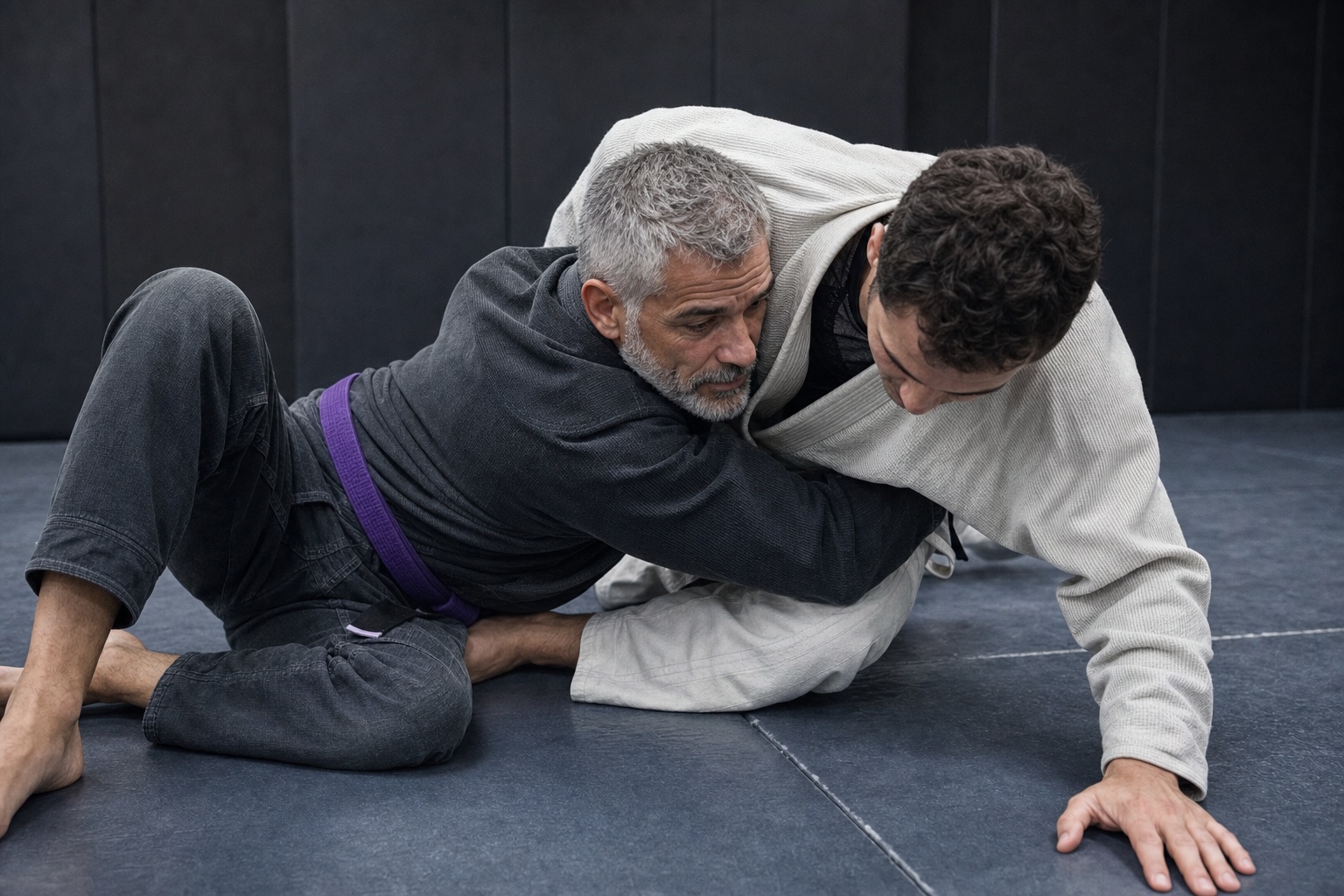
An underhook is an arm position, not a supernatural event. This distinction has not prevented vigorous promotion of the underhook as a complete retirement plan. You place your arm beneath your opponent’s arm and connect to their torso or shoulder line. What happens next depends on your head, hips, angle, and the position around it.
Used well, an underhook can help you turn onto your side, prevent a crossface, come up from half guard, control side position, pass, take the back, or enter a takedown. Used badly, it can give your opponent a whizzer, a front headlock, a D’Arce-style choke, or a scenic route to your back. The upside is real; the disclosures are extensive.
That is why “get the underhook” is incomplete advice. The real skill is learning what the underhook is supposed to control in each position.
What is an underhook in BJJ?
A BJJ underhook is an inside arm position in which your arm threads under your opponent’s upper arm, usually reaching around their back, shoulder, or waist. It helps you influence their shoulder line and reduces their ability to turn freely toward or away from you.
The underhook becomes powerful when it is connected to:
- Head position
- Chest or shoulder contact
- Hip angle
- A base that lets you drive or follow
- Control of the opponent’s far side or lower body
The arm alone is just visiting the armpit. It has not established residency or voting rights.
Why the underhook fits an efficient game
For an older or less explosive grappler, underhooks can be valuable because they create connection. Connection reduces the number of independent moving parts, which is useful in grappling and most merger agreements. It lets you use your body rather than grip with isolated arm strength.
An underhook does not “completely neutralize explosive movement,” as the old article claimed. Explosive movement remains a going concern. The underhook can, however, limit rotation, improve your angle, and give you a route to stronger whole-body control.
That makes it a central link in a low-drama BJJ game after 40.
Bottom half guard: use the underhook to get off your back
Bottom half guard is where many grapplers first learn to value an underhook.
Before reaching, establish these conditions. The underhook has a short approval process, but it does have one:
- Your head is not trapped by a deep crossface.
- You are on your side rather than flat beneath the top player.
- Your top knee or hip position blocks the top player from closing all the space.
- Your underhooking elbow can travel close to your body.
Thread the arm beneath the top player’s near arm and connect around their back or waist. Bring your head close to their chest or shoulder so they cannot easily wrap your neck. Use the underhook to pull your upper body closer and build from your bottom elbow toward your hand. Reaching deep while leaving the rest of your body behind is not connection; it is an unsecured loan.
From there, common routes include:
- Knee-tap or old-school-style sweep
- Dogfight position
- Single-leg wrestle-up
- Back-door or back-take entries when the top player turns
- Guard recovery when they withdraw pressure
The exact route should match your coach’s system and the opponent’s response.
The battle after you win the half-guard underhook
The top player will often use a whizzer, crossface, back step, or front-headlock threat.
Against the whizzer
Do not assume the overhook has defeated your underhook. The whizzer is an objection, not a final ruling. Keep your head and shoulder connected, control the lower body, and improve your knee position. Your goal is to get your hips underneath you without letting the whizzer flatten your shoulder.
Against the crossface
If the top player can turn your face away and flatten your shoulders, your underhook loses much of its value. Keep your head tight, block the crossface early, and return to half guard recovery if the upper-body battle is lost.
Against the front headlock or D’Arce threat
Do not leave your head low and your underhooking elbow flared while driving forward. Keep posture, monitor the choking arm, and disengage or reframe when your neck is exposed. If a choke is locked, tap rather than trying to prove your cervical spine supports the brand mission.
Top half guard: deny the bottom underhook
From top half guard, the underhook battle reverses. A bottom underhook can let your partner turn onto their side and come up, so top players often seek their own underhook or use head-and-arm control to flatten the bottom player.
A useful top-half sequence is:
- Control the head or shoulder line without cranking the neck.
- Win an underhook on the far arm or otherwise block the bottom player from coming up.
- Turn their knees away from their upper body.
- Free your trapped knee.
- Pass and stabilize before attacking.
Jordan Teaches Jiu-Jitsu’s half guard passing lesson shows how head control, underhooks, hip angle, and leg position work together. The important lesson is that the underhook is part of a passing system, not a detached grip.
Top side control: control the far shoulder
From standard top side control, a far-side underhook places your arm beneath the bottom player’s far arm. Combined with chest connection and appropriate head or hip control, it can:
- Limit the bottom player’s ability to turn away
- Separate their far elbow from their torso
- Support transitions to mount
- Help expose the back when they turn toward you
- Connect to arm-isolation attacks
Keep your elbow and shoulder in a strong position. A shallow underhook that reaches without controlling the shoulder can create space for the bottom player to frame or turn.
Do not remain static. Use the control to improve position. An underhook that accomplishes nothing is just an unusually intimate armrest with ongoing maintenance costs.
Bottom side control: an underhook is an escape route, not the escape
From bottom side control, an underhook can help you turn in and come to your knees or recover guard, but only after you create enough space to insert it safely.
A general sequence is:
- Protect your neck and near arm.
- Build frames and move your hips.
- Insert the underhook without exposing your neck.
- Turn onto your side and connect your head to their torso.
- Build to an elbow, hand, or knee while controlling their ability to circle behind.
If the top player has a deep crossface and your shoulders are pinned, reaching blindly for an underhook may make things worse. Recover the frame first.
Standing: pair the underhook with head and foot position
In standing grappling, an underhook can create takedown and body-lock opportunities. The same warning applies: the underhook is not enough.
You generally want:
- Your forehead or temple positioned to steer their head or shoulder
- Your underhooking shoulder connected beneath their armpit
- Your hips and feet close enough to move the whole body
- Control of the far arm, wrist, head, or waist
If your hips stay far away while your arm reaches deep, you may be vulnerable to throws, snaps, or arm attacks. Learn standing underhooks with a qualified coach and increase resistance progressively; the consequences of poor balance are higher when gravity becomes the senior creditor.
Four common underhook mistakes
1. Reaching before making space
If your opponent already controls your head and shoulder line, a long reach exposes your elbow and neck. You are expanding during a liquidity crisis. Frame and improve your angle first.
2. Ignoring head position
Your head closes space and helps direct force. An underhook with your head hanging low or turned away is much easier to counter.
3. Letting the elbow flare without purpose
Different underhooks use different elbow positions, but a disconnected elbow often gives the opponent room to pummel, whizzer, or attack the neck.
4. Holding the underhook instead of using it
The grip should lead to a sweep, pass, pin, back take, or improved alignment. If the position is not advancing, reassess the rest of your controls. Possession of an underhook is not itself a performance metric.
A three-position underhook drill
Practice the concept in three short rounds:
Round 1: bottom half guard
Bottom wins by gaining the underhook and reaching a stable elbow or dogfight position. Top wins by flattening and securing upper-body control.
Round 2: top half guard
Top wins by denying the bottom underhook, freeing the knee, and stabilizing the pass. Bottom wins by coming onto the side and building up.
Round 3: side control
Top works to secure the far-side underhook and advance to mount or back control. Bottom works to frame, recover inside position, or turn safely toward an underhook escape.
Start at low resistance and reset often. The point is to understand the relationship between arm, head, hips, and direction, not to establish who can defeat the drill by refusing to participate in it.
Video study: four kinds of underhook
Jordan Teaches Jiu-Jitsu’s guide to near-side, far-side, tight-waist, and reverse underhooks is a useful overview of how the purpose changes by position. Watch for the control objective in each example rather than copying only the arm placement.
Frequently asked questions
Which arm should underhook from bottom half guard?
Usually the top arm underhooks the top player’s near-side arm while you lie on your side. The correct arm and depth depend on the half-guard variation and your intended sweep or wrestle-up.
Is an underhook better than a crossface?
They solve different problems and are often used together from top positions. An underhook controls the shoulder and turning direction; a crossface controls head orientation. Neither is universally “better.”
What should I do when my opponent whizzers my underhook?
Protect your posture, keep your head connected, control the lower body, and improve your hip and knee position. Do not attempt to curl the opponent with your arm alone.
Can an underhook expose me to a D’Arce choke?
Yes. A poor underhook with low head position and a flared elbow can open front-headlock and D’Arce-style attacks. Learn the neck-safety details and tap when a choke is established.
The underhook is a verb
The most useful way to think about an underhook is as an action: it turns, lifts, connects, blocks, or guides. Its value comes from what it lets the rest of your body do. The arm position is the announcement; the movement is the transaction.
Win the space. Insert the arm. Connect your head and shoulder. Move your hips underneath you. Then use the control before your opponent submits a counterproposal, which they will, because the market for unopposed underhooks is not deep.
Technique references
- Jordan Teaches Jiu-Jitsu. A Guide to Underhooks: Near Side, Far Side, Tight Waist, and Reverse.
- Jordan Teaches Jiu-Jitsu. How to Pass Half Guard: BJJ Fundamentals.