Start Here
Starting BJJ at 40: A Realistic Guide to Your First Three Months
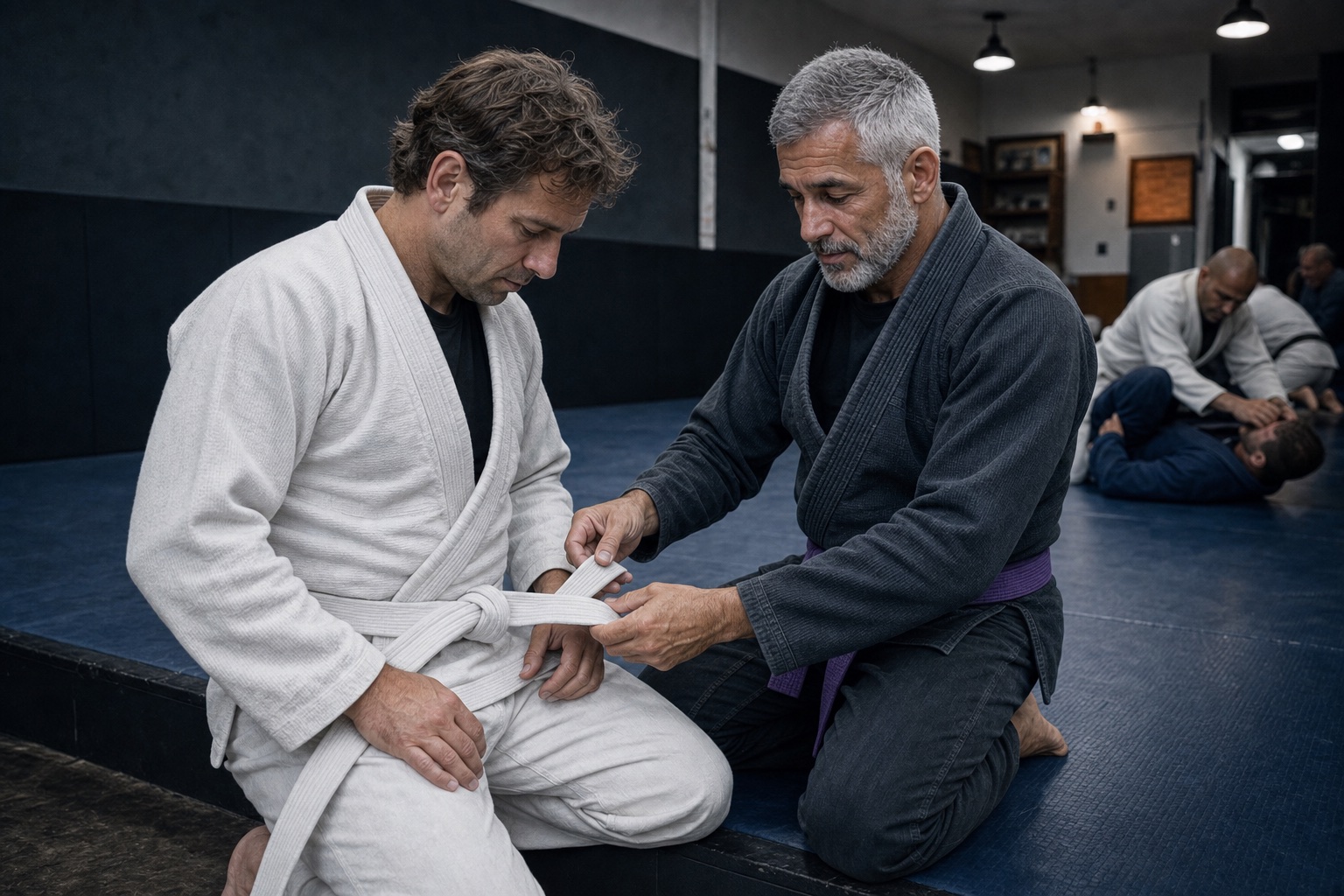
Yes, you can start Brazilian jiu-jitsu at 40. The sport has no upper age limit, although the joints do begin issuing more detailed quarterly guidance.
You do not need to get in shape first, memorize a secret vocabulary, or develop the flexibility of a child who still sits comfortably on the floor.
You do need a sensible gym, trustworthy training partners, and enough humility to be bad at something for a while. Humility is the main entry fee. The monthly dues are merely how the gym collects it.
I started later in life. I am now a purple belt, I train about three times a week when work and recovery approve the transaction, and my main goal is not to collect medals. It is to keep getting better without turning every round into an orthopedic side quest.
That perspective changes how you should approach the first three months.
The short answer: what should a 40-year-old beginner expect?
Your first three months of BJJ will probably include confusion, soreness, fast improvement in a few basic skills, and regular reminders that cardio on a bike is not the same as cardio with another person sitting on your ribs.
A good initial approach is simple:
- Start with two or three classes per week.
- Learn how to tap, breathe, frame, and protect yourself before chasing submissions.
- Choose controlled partners instead of treating every available human as a test.
- Add training only when your sleep, joints, energy, and enthusiasm are holding up.
Two consistent sessions beat five heroic sessions followed by three weeks of disappearing. The five-session plan looks better on social media, which is among its least useful features.
Month one: learn the room before trying to win it
The first month is mostly orientation. You are learning the rules of the gym, the names of positions, and why a person who weighs 145 pounds can somehow become a weighted blanket with opinions. None of this will be covered by Human Resources.
Focus on five things.
1. Learn how and when to tap
Tap when a submission is controlled and you no longer have a safe, technical escape. Do not wait for pain. Pain is the late fee, not the invoice.
Instructors should explain gym-specific tapping rules, including verbal taps and tapping with your hand or foot when your hands are trapped.
This matters more than proving you are tough. Toughness is difficult to audit and has poor resale value.
BJJ injury research is imperfect and heavily survey-based, but it consistently shows that many injuries occur during sparring and that submissions and takedowns are common mechanisms. Older age was associated with increased injury risk in one large survey of 1,140 practitioners. That does not mean you should be afraid of training. It means early communication and sensible intensity are skills, not signs of weakness.
2. Learn the major positions
You do not need fifty techniques. Learn to recognize:
- Closed guard
- Half guard
- Side control
- Mount
- Back control
- Turtle
For each position, know who is currently in danger, what a safe posture looks like, and what your first defensive priority should be. This is the org chart. It changes quickly, and you are often surprised to learn who reports to whom.
3. Stop bench-pressing people
New students often push with straight arms when trapped under side control or mount. This feels proactive, which is why it is so popular. It can also expose the arms and exhaust the shoulders.
Learn to make skeletal frames, keep your elbows closer to your body, and move your hips around those frames.
The goal is not to launch your partner into low orbit. It is to create just enough space to recover a safer position.
4. Pick your rounds intelligently
Tell your coach that you are new and want controlled rounds. Look for partners who can adjust their pace, release submissions cleanly, and help you understand what happened afterward.
Size, rank, and age matter less than self-control. You are assessing counterparty risk. A calm advanced student can be a safer round than an equally inexperienced partner who believes Tuesday night is the ADCC final and has priced the round accordingly.
5. Leave some energy in the tank
You do not have to accept every round. “No, thanks” remains legal in all major rulesets. Sitting one out is better than turning the last five minutes of class into survival by poor decision-making.
Month two: build a small defensive game
During the second month, start connecting positions rather than collecting isolated moves. Technique accumulation feels like progress because the inventory rises. Unfortunately, most of the inventory cannot be located when somebody is crossfacing you.
Your first useful sequence might be:
- Protect your neck and elbows.
- Build a frame.
- Get onto your side.
- Bring a knee or shin back between you and your partner.
- Recover half guard or full guard.
That sequence will not solve every problem, but it gives you a repeatable incident-response plan when someone passes your legs.
Half guard is especially useful because you will end up there whether you planned to or not. Our half guard recovery guide explains how to avoid getting flattened and rebuild inside position.
Month three: choose one route from each major position
By the third month, aim for a tiny, dependable map. The map will not be glamorous, but neither is being mounted while trying to remember a flying armbar tutorial.
- One escape from mount
- One escape or guard recovery from side control
- One sweep from closed or half guard
- One guard pass
- One controlled submission from a dominant position
You are not building a complete game yet. You are building a way to make decisions before your brain becomes hold music.
For many older beginners, a pressure-based pass such as the over-under pass can eventually become useful because it rewards connection and positioning. Learn it from your coach and drill the entry before trying to force it in live rounds.
How often should you train BJJ after 40?
There is no universal age-based formula. Your body is not a franchise location and cannot be operated from the standard manual. Two or three classes per week is a practical starting experiment for many recreational adults, not a medical prescription.
Adjust based on:
- How hard the classes and rounds are
- Your sleep and outside stress
- Previous injuries and current symptoms
- Other running, cycling, lifting, or sports
- Whether soreness is improving between sessions
I aim for three BJJ sessions per week, but life does not always vote yes. I also run and bike, which helps my general conditioning. That does not make me immune to getting tired under pressure; it simply gives me a better engine to work with.
If pain is sharp, worsening, changing how you move, or not settling as expected, stop guessing and talk with an appropriate healthcare professional.
What gear do you need?
For a first class, ask the gym. Many academies will lend you a gi.
The basic list is short, despite the equipment industry’s sincere effort to create additional requirements:
- A properly fitted gi for gi class
- A rash guard and grappling shorts or spats for no-gi
- A mouthguard if your gym recommends or requires one
- Water
- Sandals or slides for walking off the mat
- A bag that keeps clean and used gear separated
Wash your training clothes after every session. Trim your nails. Cover cuts according to gym policy. Do not walk barefoot into the restroom and then return to the mat carrying a tiny biological weapons program.
Unsure which format to try? Read gi vs no-gi after 40. The best first choice is usually the class with the better coach, culture, and schedule.
How to choose a beginner-friendly gym
Visit more than one academy if you can. The culture is part of the product, even when the sales conversation focuses heavily on the free trial gi.
Look for:
- Clean mats and clear hygiene standards
- Coaches who pair beginners thoughtfully
- Students who can roll hard without losing control
- A fundamentals curriculum or beginner onboarding
- A culture where tapping and asking questions are normal
- A schedule you can attend consistently
Red flags include unexplained injuries being treated as proof of toughness, beginners thrown into uncontrolled rounds, dirty facilities, and pressure to sign a long contract before you understand the program.
What I wish I had understood sooner
Starting later does not require pretending age is irrelevant. It requires becoming good at managing what you can control.
I learned to tap earlier, especially with younger partners. I learned that a round is not a referendum on my masculinity, despite the vigorous campaign materials. I learned that cardio helps, but positioning helps more. Most importantly, I learned that staying healthy enough to train next week is a better long-term goal than winning a random Wednesday.
You are allowed to be ambitious. Just make the ambition sustainable.
Frequently asked questions
Am I too old to start BJJ at 40?
Not automatically. Adults begin in their 40s and beyond, but the right gym, gradual training load, and honest attention to health matter. If you have medical concerns about starting vigorous exercise, discuss them with a qualified clinician.
Should I get fit before starting?
You can improve general fitness before or alongside BJJ, but you do not need to pass a secret conditioning exam before attending a beginner class. Start at an appropriate pace and let sport-specific fitness develop through practice.
Should a beginner train gi or no-gi?
Either can work. Gi offers clothing grips and often encourages more deliberate control; no-gi uses different grips and can involve more movement and hand fighting. Coaching quality and gym culture matter more than the uniform.
How long until I stop feeling completely lost?
You will probably feel less lost within a few months, then discover more sophisticated ways to feel lost. This is generally called promotion. Progress in BJJ is mostly the gradual replacement of panic with better questions.
The goal of your first three months
Do not measure success by taps. Measure it by attendance, composure, safer decisions, and whether you can recognize what went wrong.
Show up. Learn the room. Tap before the emergency meeting. Build a small defensive game. Then keep going.
That is not a timid way to start BJJ at 40. It is how you give yourself a chance to still be training at 50, when the joints will presumably issue another revised forecast.
Sources
- Hinz M, et al. Injury Patterns, Risk Factors, and Return to Sport in Brazilian Jiu Jitsu. Orthopaedic Journal of Sports Medicine. 2021.