Technique
Inside Camping in BJJ: How to Tire Out Lively Guard Players
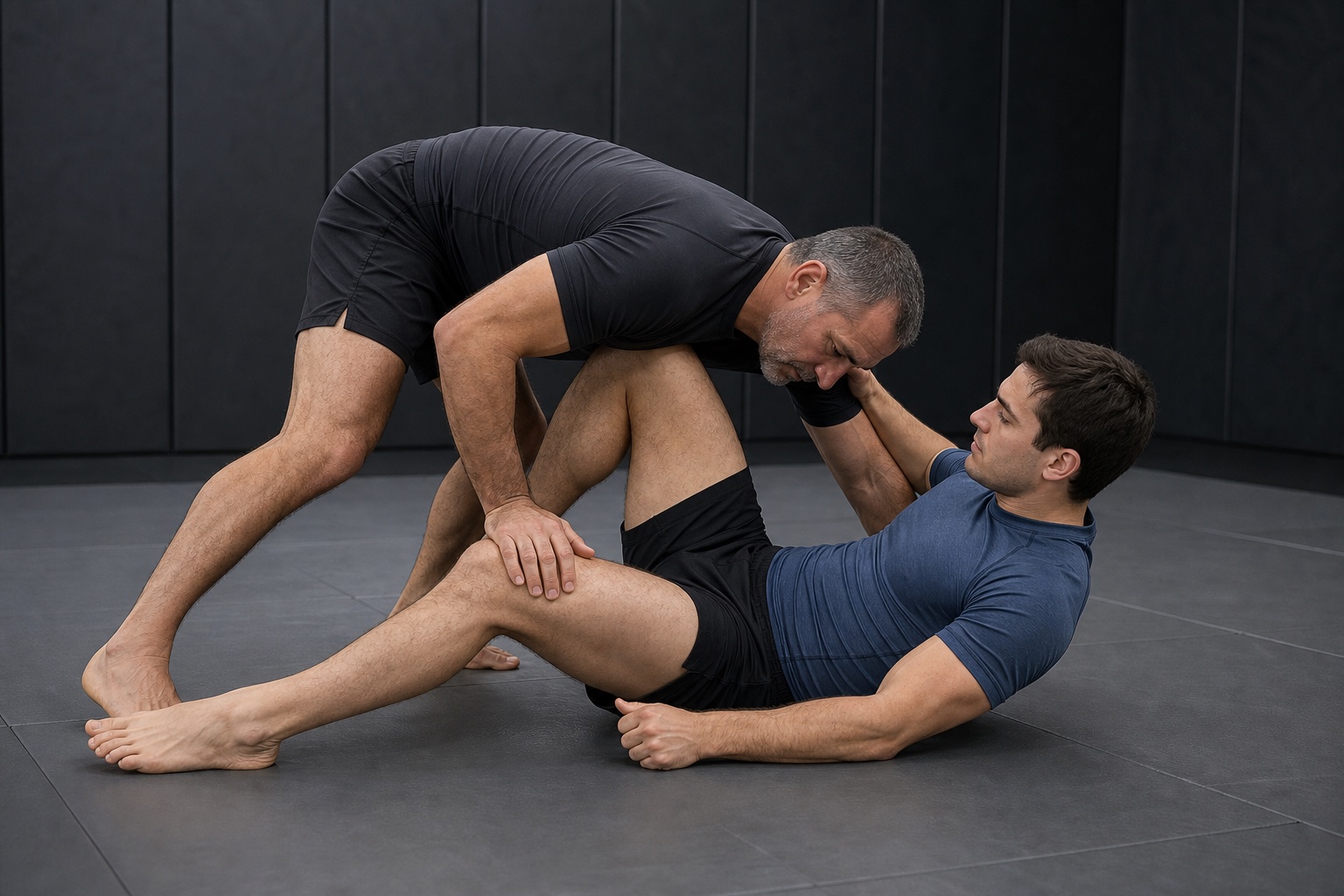
Inside camping is a no-gi guard-passing strategy that makes the bottom player carry your weight on their frames while you deny the movements they need to attack or recover. You switch between a low-head position at long range and a high-head position at close range. When the guard player gets tired, overextends a frame, or leaves a knee out of position, you advance into chest-to-chest half guard and begin passing from considerably better contractual terms.
This is useful against lively opponents because it does not ask you to become livelier than they are. That market is already crowded, and most of the participants are 24.
The important point is that inside camping is not simply lying on somebody and waiting for the heat death of the universe. It is an organized position with specific controls, distance rules, and a clear next step.
What is inside camping in BJJ?
Inside camping is a top-position guard-passing system in which the passer settles between the bottom player’s legs, accepts that the bottom player has inside frames, and uses body position to make those frames support weight without creating effective attacks.
In the featured lesson, Gordon Ryan explains two versions:
- Low-head inside camping: your hips are higher than your head. Use it when the bottom player creates long distance with knees or extended shoulder posts.
- High-head inside camping: your head is higher than your hips. Use it after the frames compress and you can close the space.
Ryan credits Roger Gracie’s high-head camping in the gi as the starting idea for that variation, then explains how he modified it for no-gi. He describes the low-head version as his own addition.
The two positions solve opposite distance problems. Low-head camping manages extension. High-head camping manages closer frames. The system is the transition between them, not a single heroic pose held until somebody files a complaint.
Why inside camping tires out active guard players
A good guard player normally wants inside position. Knees, shins, and arms inside the passer’s structure can manage distance, create elevation, and begin attacks. Inside camping does not dispute this in principle. It disputes whether those frames are currently producing anything useful.
The bottom player may have inside position, but the passer arranges the position so the bottom player struggles to:
- Put a foot back on the hip
- Invert or swing a leg high
- Sit forward and wrestle up
- Insert a useful butterfly hook
- Off-balance the passer without extending
Meanwhile, the bottom player is supporting pressure through the legs and arms. Ryan’s strategic claim is that this creates an unusually large difference in work rate: the guard player keeps paying to maintain the structure, while the passer spends relatively little energy holding a stable position.
Inside position has received a favorable analyst rating, but in this case the bottom player is financing the entire acquisition.
Eventually, many guard players make one of two decisions. They fully extend the frames to create space, which is tiring, or they let the frames compress to save energy. Low-head and high-head camping are designed to answer those choices.
Low-head inside camping: manage long-range frames
Use low-head camping when the guard player is pushing you away with long frames. Ryan specifically shows it against strong knee extension and double shoulder posts.
Your hips remain higher than your head. This lets you stay connected while respecting the distance the frames have created. High-head camping is a poor fit here because the space between your upper bodies is too large.
Ryan identifies three controls.
1. Control the knee
Grip the opponent’s knee so they cannot easily pull the leg free and replace a foot on your hip.
The knee control is not decorative. If the foot returns to your hip, the bottom player can rebuild distance and begin renegotiating the position from a much stronger department.
2. V-grip the ankle
Use a V-grip on the ankle to limit high-leg movement and inversion.
The knee and ankle controls work together. One discourages the foot from returning to the hip; the other makes it harder for the leg to travel over or around your upper body.
3. Attach your head to the far shoulder
Keep your head connected to the opponent’s far shoulder. Ryan emphasizes pinning that shoulder to stop the bottom player from coming forward, reaching effectively, or beginning a wrestle-up.
This is a recurring guard-passing principle: the far shoulder matters because the bottom player needs upper-body freedom to turn frames into motion. A loose head position can leave you technically “camping” in roughly the same way that falling asleep at a bus station is technically travel.
With all three controls, the guard player can still move, but the available movements become less productive and more expensive.
High-head inside camping: close the distance
When the bottom player stops fully extending and allows the frames to compress, switch to high-head camping. Your head rises above your hips because the distance between your bodies has closed.
Ryan’s basic high-head controls are:
- A grip on the knee
- A pulling connection on the shoulder
- Your hip connected to the opponent’s tailbone
The hip-to-tailbone connection helps deny the butterfly hook. The knee and shoulder controls keep the bottom player from freely changing the alignment while you settle your weight onto the frames.
Then you wait.
This is where the name becomes useful. You are setting up camp, although the camping is metaphorical. There is no tent, no fire, and very little chance that anyone will describe the ground as pristine.
Waiting does not mean going limp. Your base, hip connection, head height, and controls must keep the bottom player from converting their frames into a real off-balance. You are resting inside a maintained structure, not outsourcing balance to chance.
Switch positions when the distance changes
The simplest operating rule is:
- Frames extend and create distance: move to low-head camping.
- Frames collapse and distance closes: move to high-head camping.
Ryan demonstrates moving back and forth between the two. When the bottom player pushes, the passer lowers the head and controls the extended structure. When the bottom player relaxes the frames, the passer closes in and raises the head.
This is the real technique. If you choose one camping position regardless of distance, you are no longer running a system. You are expressing a preference.
The guard player now has an unpleasant allocation problem. Extending creates space but costs energy. Compressing saves the arms and legs but allows the passer to close distance. The passer does not have to win every exchange immediately; the passer needs the choices to become progressively worse.
How the pass develops from inside camping
The goal is not to remain in camping forever. The goal is to make the guard player overwork, overextend, or misplace a frame and then take the space that appears.
In the featured sequence, the bottom player overextends the top knee while trying to off-balance the passer. The passer moves beyond that knee, clears the bottom knee, and settles chest to chest in half guard.
The sequence is:
- Establish high-head or low-head camping at the correct distance.
- Deny meaningful off-balancing and guard recovery.
- Let the guard player work against the position.
- Watch for the top knee to extend or drift out of place.
- Move beyond the top knee.
- Clear the bottom knee line.
- Settle chest to chest in top half guard.
- Flatten and pass using your preferred half-guard system.
After several minutes of carrying weight on frames, the bottom player now has to carry pressure chest to chest. The service has technically improved, but only for the provider.
From top half guard, the BJJ underhook becomes important for controlling the upper body and preventing the bottom player from turning onto a strong side. If your broader passing game favors steady pressure, the over-under pass belongs to the same general family of decisions: connection first, movement second, unnecessary cardio subject to committee review.
Video study: Gordon Ryan explains inside camping
Gordon Ryan’s lesson is the primary technical source for this article. Watch how the head height changes with distance, then look at the three controls in each variation. The useful part is not merely seeing the final pass. It is seeing why the bottom player’s frames stop creating productive movement.
The most important sections are:
- 1:31: low-head versus high-head inside camping
- 2:26: the three low-head controls
- 3:36: transitioning as the frames collapse
- 3:50: the three high-head controls
- 4:24: making the bottom player work on the frames
- 4:50: clearing the knees into chest-to-chest half guard
- 5:16: switching between high-head and low-head positions
- 6:05: the work-rate argument and application for older grapplers
Common inside camping mistakes
Using high-head camping from too far away
If the opponent has fully extended knees or double shoulder posts, the upper-body distance is too large for the high-head structure Ryan demonstrates. Lower the head and manage the long frames first.
Controlling the leg but forgetting the far shoulder
Knee and ankle control do not automatically prevent a sit-up or wrestle-up. Head connection to the far shoulder is one of the central low-head controls, not a formatting preference.
Resting without maintaining balance
Inside camping is low-output, not no-structure. If your weight drifts beyond your base, a good guard player will off-balance you and the camping trip will end with an unscheduled local excursion.
Trying to force the pass too early
The position is built around patience. If you abandon your controls to chase the pass before the knee overextends, you may give the bottom player the freedom that the position was designed to remove.
Treating body weight as the entire technique
The pressure comes from alignment, controls, and connection. Being heavier may increase the cost of the frames, but weight without positional discipline is just a larger mistake.
Forgetting that the guard player can change the problem
Partners may pummel, invert, wrestle up, enter the legs, or disengage depending on your exact placement and their preferred game. The video introduces a system, not a warranty. Learn the position from a qualified coach and begin with cooperative drilling before testing it against live resistance.
Why inside camping fits a BJJ game after 40
Ryan specifically recommends the concept for older or less athletic grapplers facing younger partners. The appeal is not that age turns gravity into a superpower. It is that the position shifts the contest away from repeated speed and toward balance, alignment, pressure, and patient decision-making.
That fits the larger goal of building an efficient BJJ game after 40: choose positions that connect, limit the opponent’s best options, and do not require a fresh explosive movement every eight seconds.
Younger training partners are welcome to remain more athletic. Inside camping merely asks them to demonstrate it while carrying additional operating costs.
There is also a psychological advantage. Active guard players often expect the top player to respond to movement with more movement. A stable passer changes that conversation. The bottom player must keep generating action while the top player waits for the action to become careless.
This is particularly attractive in longer rounds, where a modest difference in work rate can accumulate into a meaningful technical difference. In a short round, you may not have several minutes to conduct a patient exhaustion program, so the clock and training goal still matter.
A simple inside camping drilling progression
This progression is an application of the concepts in Ryan’s lesson, not a substitute for coaching.
Round 1: hold low-head camping
Start with the bottom player using long knee frames or double shoulder posts. The top player establishes the knee grip, V-grip on the ankle, and head connection to the far shoulder.
The bottom player moves at low intensity for 20 to 30 seconds. The top player’s only job is to maintain alignment and deny foot-on-hip recovery, inversion, and the wrestle-up.
Round 2: recognize the distance change
The bottom player alternates between extending and compressing the frames. The top player switches between low-head and high-head camping without attempting the pass.
This develops the decision before adding the finish. Decisions are cheaper to repair during drilling than during a live round, where they acquire witnesses.
Round 3: finish only after overextension
The bottom player begins controlled off-balancing attempts. The top player waits for the top knee to overextend, then clears the knees and settles into chest-to-chest half guard.
Reset after the chest-to-chest position is stable. Do not rush immediately into a submission. The objective is to recognize the opening and secure the next position.
Round 4: positional sparring
Begin from either camping variation. The bottom player wins by recovering a strong open guard, entering a meaningful attack, or wrestling up. The top player wins by reaching stable chest-to-chest half guard or completing a pass.
Start with moderate resistance. “Learning a low-energy system” and “making every repetition a small legal dispute” are different projects.
Frequently asked questions
Is inside camping the same as stalling?
No. The passer is using controls to restrict guard recovery, invite predictable reactions, and create a path to chest-to-chest half guard. If you are merely stationary without denying attacks or improving the position, you may have omitted the technical portion of the plan.
What is the difference between low-head and high-head camping?
Low-head camping has the hips above the head and addresses long-distance frames. High-head camping has the head above the hips and is used after the distance closes. Switch between them according to the bottom player’s frame extension.
Does inside camping work in the gi?
The featured lesson is focused on no-gi. Ryan says his high-head variation began with an idea he felt while training with Roger Gracie in the gi, which he then adapted for no-gi. Gi grips will change the available controls and reactions, so work with a coach before assuming the no-gi details transfer unchanged.
Is inside camping good for older grapplers?
It can be. The system rewards patient pressure and creates a favorable difference in work rate instead of demanding constant speed. It still requires balance, correct controls, and enough positional awareness to manage inversions, wrestle-ups, and leg attacks.
What should I do after the opponent overextends?
Ryan demonstrates moving beyond the top knee, clearing the bottom knee, and settling chest to chest in half guard. From there, establish upper-body control, flatten the bottom player, and use a half-guard passing sequence you understand.
Can I use inside camping against butterfly guard?
High-head camping includes a hip-to-tailbone connection intended to deny the butterfly hook. Exact results depend on alignment and reaction, so drill the position rather than assuming the connection makes hooks administratively illegal.
The bottom line
Inside camping gives a patient passer a way to manage an energetic guard without trying to match its pace. Use low-head camping when the frames create long distance. Use high-head camping when the frames compress. Control the knee, ankle, shoulder, and hip line well enough that the bottom player carries pressure without converting the frames into attacks.
Then wait for the overextension and move into chest-to-chest half guard.
The opponent may still be more athletic than you. The position simply gives them an opportunity to become tired enough that the distinction requires additional testing.
Sources
- Gordon Ryan. Gordon Ryan’s Secret to Inside Camping. Video lesson and locally transcribed audio, accessed August 21, 2026.
- John Davis. Gordon Ryan breaks down the Inside Camping position by modifying Roger Gracie’s Gi tech. BJJ Doc, June 9, 2025. Used to cross-check names and technical terminology against the machine transcript.